|
|
课 题
| Unit 9 Have you ever been to a museum?(第1课时)
| 教学批注
| 教 学 设 计
| 一、教学三维目标
| | | Knowledge and Ability Objects
(1) Key vocabulary: amusement; neither
(2) Listening practice.
(3) Target language:
Lets' go somewhere different today.
Have you ever been to…? Yes, I have./ No, I haven’t.
How about/what about…?
How are we going to get there?
We can take the subway/…
(4) To train students’ listening and speaking skills.
| | | 2.过程与方法:
Method Objects in Teaching
(1) Scene teaching method.
(2) Listening and speaking methods.
(3) Pair work
| | | 3.情感态度与价值
To be interested in taking part in all kinds of activities in English class.
| | | 二、教学重点、难点
| | | 1. Teaching Key Points
1. Key vocabulary in this period.
2. Target language in this period.
2. Teaching Difficulty
Make conversations freely using the target language.
| | | 三、教学准备
| | | Teaching Aids
1. A tape recorder.
2. A computer for multimedia use.
| | | 四、教学课时
7课时
| | | 五、教学过程
| | | Step 1 Greetings and Revision
Greet the class and check the homework.
Step 2 Lead-in
Guess the places of the pictures; they are the British Museum, space museum, history museum, water park, zoo, amusement park while lead in sentence patterns:“ Have you ever been to …?”
Speaking
Get students to work in pairs to practice the conversation: “ Have you ever been to…”
“Yes, I have”/ Not, I haven’t.
Step 3 Pre-listening
1. Section A 1a
T: OK. Now open your books on Page 65. In Part 1a, 6 places are given. Please read the names of these places. (Teacher writes the names on the blackboard.) Which of these places would you like to visit? Rank them from 1 to 5.
S 4: Amusement park _____, water park _____, zoo _____ aquarium _____ space museum _____.
S 5: Space museum _____, aquarium _____, zoo _____, water park ____, amusement park _____
S6: …
2. Talk about the picture
Step 4 Listening
Listen and choose the best answer. The first and the second question aim to listening to time, and the third one aims to listen for the relationship. This activity trains students’ listening ability for listening for specific relationship.
1)When did Sarah visit the National Science Museum?
A. Today B. Yesterday C. Last year
2)When did Claudia visit the nature museum?
last year B. last summer C. Last school trip
3)What may the relationship be between the two speakers?
A. Friends B. Teacher and student
C. Mother and kid.
Answer: CCA
| | 教 学 设 计
| Listen again. Listen and check the boxes. Have these students ever been to these places?
| Science museum
| History museum
| Art museum
| Nature museum
| Space museum
| Claudia
|
|
|
|
|
| Sarah
| √
|
|
|
|
|
Step 5 Speaking
Ask and answer in pairs:
A: let’s go somewhere different today.
B: OK. Where do you want to go?
A: Have you ever been to the space museum?
B: No, I haven’t. How about you?
A: …
Step 6 Listening 2a 2b
Listen and circle the places that you hear.
Listen again and circle T for true or F for false.
Conversation 1
1. Tina went to the space museum last year. T/F
2. John has never been to the space museum. T/F
3. They are going to take the subway. T/F
Conversation 2
1. Linda has been to the amusement park. T/F
2. Linda went to the amusement park yesterday. T/F
3. Linda is going to the amusement park again by bike. T/F
Conversation 3
1. Frank had a great time at the water park. T/F
2. Frank’s friend has never been to the water park. T/F
3. Frank and his friend are going skating. T/F
Answer: TFT TFT FTT
Speaking
Look at the map in 2a and make conversations about the places.
A: Have you ever been to the space museum?
B: Yes, I have. How about you?
A: No, I haven’t.
B: Oh, it’s fantastic. Let’s go tomorrow.
A: OK. How are we going to get there?
B: We can take the subway.
Speaking
Role-play the conversation in 2d.
| | 教 学 设 计
| A: I went to the film museum last weekend. Have you ever been there? …
B: Yes, I have. I went there back in April. …
…
Step 7 Language points
1. I learned about the inventions that led to color movies, too.
我还了解了一些发明,它们成就了彩色电影。
此处learn是“了解;获知;得知”的意思,由介词about或of引入所获知的具体内容。例如:
The children were all shocked to learn of the death of their headmaster.
得知校长去世,孩子们都十分震惊。
I only learned about the accident later. 我只是后来才得知了事故的情况。
2. I’ve never been camping. 我从未野营过。
此句为现在完成进行时。这一时态的结构为“have been + 现在分词”,表示从过去某一时刻延续至今的动作。在本句中,说话人使用这一时态来强调自己至今从未有过野营的经历,欠缺这方面的经验。又如:
He’s been watching TV all afternoon. 他一下午都在看电视。
We’ve been living like this ever since the birth of my little brother.
自打我小弟弟出生,我们就一直这样生活。
Exercise
1. 我去过北京两次。I ______ ______ _____ Beijing twice.
2. 大声读书是一种学习英语的好方法。Reading aloud __ ____ ____ ____ to learn English.
3. 昨天他没有去那,我也没去。He didn’t go there yesterday. _____ _________.
4. 我了解了一些电影的知识。I ______ ______ some information about movie.
5. 他的粗心导致了这次失败。His carelessness _____ _____ this failure.
选用have, has填空:
1. I _______ told him the news.
2. She ________ come back from school.
3. You ________ won the game.
按要求改写下列各句:
4. They have bought a computer. (改成否定句)___________________________________
5. He has lost his book. (先改成一般疑问句,再作肯定与否定回答)
___________________________________ ___________________________________
Step 8 Homework
1. Practice the dialogue and remember the language points.
2. Preview the next lesson.
Step 9 Blackboard Design
| | 教 学 反 思
| | |
课 题
| Unit 9 Have you ever been to a museum?(第2课时)
| 教学批注
| 教 学 设 计
| 一、教学三维目标
| | | I. Knowledge and Ability Objects
1. Key vocabulary: unbelievable, progress, rapid, unusual, toilet, encourage, social, peaceful, performance, perfect, itself, collect
2. Target language:
1) I wonder how much more computer will be able to do in the future
2) Watching them prepare the tea with the beautiful tea sets is just as enjoyable as drinking the tea itself
3. To train students’ reading ability
4. To get students know some knowledge about many kinds of museums.
| | | 2.过程与方法:
Method Objects in Teaching
1) Skimming for details.
2) Reading for comprehension.
3) Communicative approach.
| | | 3.情感态度与价值
To raise students’ interest of learning English.
| | | 二、教学重点、难点
| | | I. Teaching Key Points
1. Key vocabulary: unbelievable, progress, rapid, unusual, toilet, encourage, social, peaceful, performance, perfect, itself, collect
2. Target language:
1) I wonder how much more computer will be able to do in the future
2)Watching them prepare the tea with the beautiful tea sets is just as enjoyable as drinking the tea itself
II. Teaching Difficulties
1) How to improve reading skill.
2) To understand the passage and the culture.
| | | 三、教学准备
| | | Teaching Aids
1. A computer for multimedia use.
| | | 四、教学课时
7课时
| | | 五、教学过程
| | | Step 1 Greetings and Revision
Look at the pictures and make conversation:
A: Have you ever been to…?
B: Yes, I have./ No, I haven’t.
Step 2 Pre-reading
Brainstorm: think of the kinds of museums that you can name.
Watch a video. A video about the International Museum of Toilets
Talk about the video.
Step 3 Fast reading
Match the words with its meaning and learn some new words.
True or False
( ) 1. American Computer Museum only has information about different computers there.
( ) 2. Ken thinks computers will do more work in the future.
( ) 3. International Museum of Toilets is a very unusual museum.
( ) 4. India has the most advanced toilet.
( ) 5. Linlin didn’t know why her grandpa loved drinking and collecting tea set.
Step 4 Detailed reading
Read the passage again and answer the questions.
Which three museums do the students talk about?
What does Ken say about the American Computer Museum?
3. What can we learn at the International Museum of Toilets?
4. Why is the Hangzhou National Tea Museum a nice place to enjoy tea?
5. What do you think is the most interesting thing about each museum?
Step 5 Explanation
1. The most interesting museum I’ve been to is the American Computer Museum.
多音节词和部分双音节形容词最高级加most构成,前面加the。如: the most beautiful girl
2. The old computers were much bigger.
much可修饰形容词比较级,表示……得多。如: much richer
a little, even, a bit也可以修饰形容词比较级。
3. I wonder how much more computer will be able to do in the future.
不知道将来电脑还能够做些什么事情呢。
1)wonder 表示“ (对某事)感到疑惑; 想要知道; 想弄明白; 琢磨”, 后面常接由what, how, who 或者if/whether引导的宾语从句。
e.g. I wonder how they’re getting on. 我想知道他们现在过得怎样。
I just wonder if they’ve arrived safely.我就想知道他们是否安全抵达了。
2) 此句从句部分的原始结构是: How much more will computers be able to do in the future? 是对陈述句Computers will be able to do (much) more in the future.(电脑将来能够做更多的事情。)的提问。由于充当了宾语从句, 疑问结构改成了陈述结构: how much more computers will be able to do in the future, 即: 将助动词还原到陈述句的位置。
e.g. I don’t know when he will come.我不知道他什么时候来。
I don’t know where he lives.我不知道他住在哪里。
4. It also encourages governments and social groups to think about ways to…
| | 教 学 设 计
| encourage sb. to do sth.
鼓励某人做某事
e.g. My father encouraged me to take part in the sports meeting.
父亲鼓励我参加运动会。
5. Watching the tea preparation is just as enjoyable as drinking the tea itself.
看沏茶的过程和饮茶本身一样令人愉快。
-able是一个典型的形容词后缀, 可加在动词之后, 表示“可…..的; 能够……的”。此处enjoyable(能使人快乐的; 令人愉快的) 便是一例, 再如:drinkable(可饮用的), washable(可洗的), readable(可读的), usable(可用的; 可使用的)等等。
Step 6 Homework
1. Remember the words and expressions.
2. Finish the exercises in the workbook.
| | 教 学 反 思
| | |
课 题
| Unit 9 Have you ever been to a museum?(第3课时)
| 教学批注
| 教 学 设 计
| 一、教学三维目标
| | | Knowledge and Ability Objects
1) Target language:
Have you ever been to a science museum?
Yes, I’ve been to a science museum./
No, I’ve never been to a science museum.
Have you ever visited the space museum?
Yes, I have. I went there last year./
No, I haven’t.
I’ve been to the art museum many times.
Me, too. And I’ve also visited the nature museum.
| | | 2.过程与方法:
Method Objects in Teaching
(1) Explanation method.
(2) Exercise methods.
| | | 3.情感态度与价值
| | | 二、教学重点、难点
| | | Teaching Key Points
1. The present perfect tense.
2. How to use the present perfect tense.
2. Teaching Difficulties
To understand and use the present perfect tense.
| | | 三、教学准备
| | | Teaching Aids
1. A computer for multimedia use.
2. A picture.
| | | 四、教学课时
7课时
| | | 五、教学过程
| | | Step 1 Greetings and Revision
Greet the class as usual and check the homework.
Ask students to read the sentences of Grammar focus aloud.
Step 2 Learn the Present Perfect Tense
1. 用法
肯定式
| 否定式
| I/You/We/They have finished the work.
He/She/It has finished the work.
| I/You/We/They have not finished the
work.
He/She/It has not finished the work.
|
构成:
have(助动词) + p.p
has(第三人称单数助动词) + p.p
疑问式
| 回答
| Have I/you finished the work?
Has he/she finished the work?
| Yes, you/I have.
No, you/I haven’t.
Yes, he/she has.
No, he/she hasn’t.
|
have not 常缩略为haven’t
has not 常缩略为hasn’t
现在完成时的用法
Have you had your lunch yet?
Yes, I have. I have just had it.(现在我不饿了)
| 表示过去发生或已经完成的动作对现在造成的影响或结果。
| I haven’t seen her these days.
I have known Bob for three years.
I’ve been at this school for over two years.
They have lived here since 1982.
She has taught us since I came to this school.
| 某些动词的现在完成时可表示过去某一时间开始并一直持续到现在(包括现在)的动作或者状态,可以和表示延续的时间状语连用。表示持续动作或状态的是延续性动词。
|
ever 意为“曾经”,用于疑问句或否定句中,放在助动词与过去分词之间。
| | 教 学 设 计
| e.g. Have you ever been to Hong Kong?
你曾去过香港吗? I haven’t ever spoken to her.
我未曾和她说过话。
never意为“从来没有”常与before连用,多放在助动词与过去分词之间。
e.g. I have never travelled by plane before. 我以前从来没有乘飞机旅行过。
2. have been to & have gone to区别
比较:He has been to Beijing. 他曾去过北京。(人已回来,可能在这儿)
He has gone to Beijing. 他已经去北京了。(人已走,不在这儿了)。
have / has been (to) 表示“曾经到过某地”,说话时此人不在那里,已经回来。侧重指经历。
have / has gone (to) 表示某人“已经去某地了”,说话时此人可能在路上或已到那里,反正不在这里。
3. 一般过去时与现在完成时的区别
比较:I have seen the film.. 我看过这部电影。(我了解这部电影的内容)
I saw the film last month. 我上个月看了这部电影。
(只说明上星期看了这部电影,不涉及现在情况)
一般过去时的时间状语有:yesterday, last week,…ago, in1980, in October, just now…
共同的时间状语有:this morning, tonight, this summer, before, already, …
现在完成时的时间状语有:for, since, ever, never, just, already, yet, in past years, …
Step 3 Exercises
1. Finish exercises.
I. 根据括号内的要求完成下列各句,每空一词(含缩写)。
1. My parents have come back already. (改为否定句)
My parents _______ ______ back ____.
2. The boys have been to Japan lots of times. (改为一般疑问句)
_______ the boys _______ to Japan lots of times?
3. Has your sister gone to the bookstore? (作肯定回答)
_______, she _______.
4. I have been to the theme park three times. (对划线部分提问)
_____ ______ times have you been to the theme park?
5. The movie has been on for half an hour. (对划线部分提问)
_____ _______ has the movie been on?
Ⅱ. 根据括号中所给动词的提示完成下列句子或对话。
1. I ____________________ (work) in this city for 7 years.
2. — How long ______ she ______ (live) here?
— Since she ______ (get) a new job here.
| | 教 学 设 计
| 3. How many words _____ you ______________ (learn) since two years ago?
4. My mother ____ never ________ (hear) of this man.
5. Tom _________ (be) to China twice.
2. Finish 4a on textbook. Put the correct form of the verbs in the blanks.
1. A: Do you want ________ (come) to the space museum?
B: No, I’ve already ______ (be) there three times.
2. A: Have you _____ (see) the robots at the science museum?
B: Yes, I _____ (go) there last weekend.
3. A: Let’s _______ (spend) the day at the zoo.
B: Well, I’ve already ______ (be) there a couple of times, but I’m happy _______ (go) again.
4. A: How about ______ (go) to the art museum? There are some special German paintings there right now.
B: Sure. When do you want _____ (go)?
5. A: Have you ever _______ (visit) the history museum?
B: No, I’ve never ______ (be) there.
3. Finish 4b on textbook. Fill in the blanks with the correct forms of the verbs in brackets.
Most of us ____________ (see) Mickey Mouse, Donald Duck and other famous Disney characters in cartoons before. But have you ever ______ (be) to Disneyland? Disneyland ______ (be) an amusement park with a special theme — Disney characters and movies. There _____ (be) many exciting rides, lovely restaurants and fantastic gift shops there. You can also _____ (see) the Disney characters walking around the park. And have you ever _______ (hear) of a Disney Cruise? This ______ (be) a boat ride with a Disney theme. You can ______ (take) a ride on the boat for several days and eat and sleep on it. On the boat, you can ______ (shop) and have Disney parties before you ________ (arrive) at the Disney island.
4. Finish 4c on textbook. Answer the survey questions and then ask your partner.
Have you ever ...
| You
| Your partner
| been to another province in China?
|
|
| lost something important?
|
|
|
|
|
|
|
|
|
|
|
|
Step 4 Summary
| | 教 学 反 思
| | |
课 题
| Unit 9 Have you ever been to a museum?(第4课时)
| 教学批注
| 教 学 设 计
| 一、教学三维目标
| | | Knowledge and Ability Objects
(1) Key vocabulary:
the Terracotta Army, the Great Wall
the Bird’s Nest, the Palace Museum
Singapore, population, southeast Asia, western food, Indian food, Night Safari…
(2) Target language:
Have you visited …?
Have you been to …?
Have you seen …?
Have you tried …?
(3) To train students’ listening, speaking reading abilities and skills..
| | | 2.过程与方法:
Method Objects in Teaching
(1) Listening and speaking methods.
(2) Reading methods.
(3) Practice method.
| | | 3.情感态度与价值
(1) To raise students’ interest of learning English.
(2) To make students get to know cultures of other countries.
| | | 二、教学重点、难点
| | | Teaching Key Points
1. Key vocabulary in this period.
2. Target language in this period.
2. Teaching Difficulties
1. Improve students’ listening.
2. Improve students’ reading skills.
| | | 三、教学准备
| | | Teaching Aids
1. A computer for multimedia use.
2. A tape recorder.
| | | 四、教学课时
7课时
| | | 五、教学过程
| | | Step 1 Revision
Complete the sentences.
Step 2 Pre-listening
1. Look at the pictures and learn the new words.
thousand num. 一千 thousands of 数以千计的 safe adj.安全的
fear v.& n.害怕;惧怕 Indian adj.印度人;印度的 spring n.春天
Japanese adj.日本人;日本的 fox n.狐狸 equator n.赤道
2. Look at the pictures and review the sentence pattern: Have you ever been to…?
3. Finish exercise 1a on textbook. Match the pictures with names.
_________ the Terracotta Army
_________ the Great Wall
_________ the Bird’s Nest
_________ the Palace Museum
Keys: c, a, d, b
Step 3 Listening
1. Listen to a student interviewing a foreign student. Check (√) the question you hear.
_______ Have you visited the Palace Museum?
_______ Have you been to the Great Wall?
_______ Have you been to the Bird’s Nest?
_______ Have you seen the Terracotta Army?
_______ Have you tried Chinese food?
Keys: 1,3, 5
2. Listen again and take notes.
Name: _____________________________________
Country: ___________________________________
How long in China ________________________
Places visited: ____________________________
Food: __________________________________
Keys: Peter, Australia, two weeks, the Palace Museum, the Great Wall, the Bird’s Nest, the Terracotta Army, Beijing Duck
Step 4 Speaking
Work in pairs to ask your partner where she/he has been to?
Have you visited …?
Have you been to …?
Have you seen …?
Have you tried …?
Step 5 Reading
1. Introduction of Singapore
Look at some pictures and watch some videos about Singapore
Talk about the symbol of Singapore
| | 教 学 设 计
| 2. Fill in the blanks according to the article.
Singapore’s geographical position
| A small island (1) ____________
| Language(s) people speak in
Singapore
| (2) ______________________
| Food we can find in Singapore
| Chinese food, (3) __________ and
Japanese food.
| Name of the night zoo in Singapore
| (4) ___________
| Temperature in Singapore
| It is (5) _________
_____ all year round.
|
Keys: 1. in Southeast Asia 2. Putonghua and English 3. Indian food, western food 4. Night Safari 5. almost the same
4. Work on 2b. Read the article. How many reasons can you find for visiting Singapore?
5. Work on 2c. The statements below are false. Use information from the article to correct them.
1. Most people in Singapore only speak English.
2. It is not easy to get many different kinds of good food in Singapore.
3. It’s better to see lions and tigers during the daytime because they will probably be awake.
4. It’s best to visit Singapore in the autumn.
Keys: 1. both English and Chinese 2. very easy 3. at night 4. whenever you like
6. Work on 2d. Fill in conversation about Singapore using the information form the article.
A: I am going to Singapore next week. _____ you ever ____ there before?
B: Yes, I’ve ____ to Singapore many times. It’s my favorite country in ____ Asia.
Step 7 Exercises Translate the following phrases.
1. 在东南亚 _______ 2. 四分之三人口 ________3. 做某事有困难 ________
4. 在白天 _________ 5. 睡醒 _______6. 处于一个自然的环境中 ____
7. 一年到头,终年 _____________
Keys: in southeast Asia, three quarters of population, have problems doing sth., during the daytime, wake up, in a natural environment, all year round
Step 8 Homework
Make some notes about Singapore. Write down anything that you remember.
| |
课 题
| Unit 9 Have you ever been to a museum?(第5课时)
| 教学批注
| 教 学 设 计
| 一、教学三维目标
| | | (1) Target language.
Have you ever tried/seen/been…?
If you…, you will/can…
You should…
One great thing about …is…
(2)To train students speaking and writing abilities.
| | | 2.过程与方法:
Method Objects in Teaching
Writing methods.
| | | 3.情感态度与价值
To be interested in taking part in all kinds of activities in English class.
| | | 二、教学重点、难点
| | | 1. Teaching Key Points
Target language in this period.
2. Teaching Difficulties
Improve students’ writing ability.
| | | 三、教学准备
| | | Teaching Aids
1. A computer for multimedia use.
2. Survey papers.
| | | 四、教学课时
7课时
| | | 五、教学过程
| | | Step 1 Revision
What do you know about Singapore?
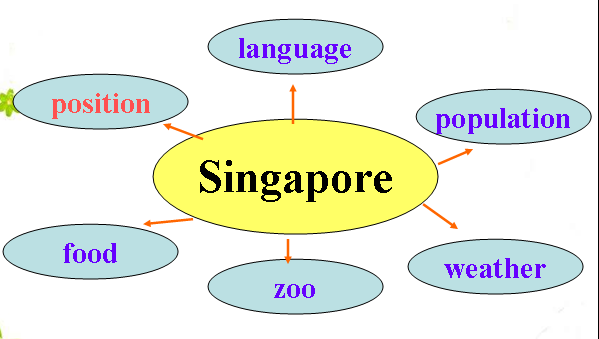
position: Where is Singapore?
position: in Southeast Asia
Population
More than three quarters of the population are Chinese.
Language
Chinese and English.
Food
A lot of food from China, such as rice, noodles and dumplings.
Indian food, western food and Japanese food.
Zoo
Singapore has a special zoo called the “Night Safari”. A lot of animal only wake up at night, so this is the best time to watch them.
Weather
The temperature is almost the same all year round.
Step 2 Writing
3b Write an article to advertise your hometown or a place you have been to.
句型:
Have you ever tried/seen/been…?
If you…, you will/can…
You should…
One great thing about …is…
Step 3 Self check
1. Think about the things below and write an answer for each one.
1) One thing that you have collected before:
_________________________________
2) One invention that you have found to be very useful:
_________________________________
3) One unbelievable or unusual thing that you’ve seen or heard recently:
_________________________________
4) One way that you’ve used to encourage a friend in the past:
_________________________________
5) One peaceful and quiet place that you’ve been to recently:
________________________________
| | 教 学 设 计
| 2. Complete the conversation.
Get students to complete the conversation. This activity provides writing practice in understanding and writing the target language.
A: Hey, John. ______ are you doing this weekend?
B: Not much, Mark. I don’t really have any plans yet.
A: ______ you ever been to the space museum?
B: ______, I have. I ______ there last month.
A: Oh, how ______ it?
B: It was great. I ______ been there many times.
A: I see. I _____ never _______ there.
B: Well, let’s go this weekend then. I don’t ______ going again. I think there’s something new there. I _____ not see it last time.
A: Perfect!
Get students to role play the conversation. This activity gives students practice in using the target language.
3. Complete the chart.
Have you ever been to a/an…
| How many times?
| What did you see/do there?
| home for old people?
|
|
| farm?
|
|
| amusement
park?
|
|
|
|
|
|
Step 4 Homework
Writing
写作要求:写一篇80字的文章描述你的家乡或者你去过的地方。
句型:
Have you ever tried/seen/been…?
If you…, you will/can…
You should…
One great thing about …is…
| | 教 学 反 思
| | |
教 学 设 计
| Unit 9 Have you ever been to a museum?(第6-7课时)
Unit 9 Have you ever been to a museum?检测题
一.单项填空(共15小题;每小题1分,满分15分)
从每小题所给的A、B、C、D四个选项中选出一个可以填入空白处的最佳选项。
( ) 1. I don’t like those two coats because ________ of them fits me.
A. either B. neither C. none D. all
( ) 2. ––I really want to go to the . How about you?
–– So do I. We can swim in it.
A. water park B. aquarium C. zoo D. space museum
( ) 3. ____ is fun to learn another language.
A. That B. This C. It D. What
( ) 4. ––I hear your teacher ____ to Japan once. ––Yes, he ____ there last year.
A. goes; went B. has been; has been
C. went; went D. has been; went
( ) 5. –– _______ have you been studying English? –– Since last year.
A. How far B. How soon C. How long D. How often
( ) 6. The Smiths have lived here with us ________ 1999.
A. for B. since C. before D. in
( ) 7. –– I have never been to Disneyland. How about you? –– .
A. Me, too B. So do I C. Me, neither D. Yes, I have
( ) 8. When my mother came back home last night, I was still _________.
A. wake B. woke C. waking D. awake
( ) 9. ––Tina, we are going to take a holiday in Europe. ––_________.
A. It’s wonderful B. With pleasure C. That’s OK D. Have a good time
( ) 10. Jim needs _____ his English if he wants to be a flight attendant(服务员).
A. to improve B. improve C. discover D. to learn
( ) 11. The island is quite warm all year round, because it’s ________ the equator.
A. next B. close to C. far from D. across from
( ) 12. Linda __________ the space museum after school yesterday.
A. has been to B. was going to C. went to D. goes to
( ) 13.-Tell us something about Canada, OK?
-I’m sorry. _________ Jack _________ I have ever been there.
A. Either; or B. Not only; but also C. Both; and D. Neither; nor
( ) 14. My sister would like to be a dancer ____a singer. She likes dancing more.
A. rather than B. than rather C. would rather D. more rather
( ) 15. ________you are free, come to my home and let’s have some coffee.
A. Whatever B. Whenever C. Whoever D. However
二.完形填空(共10小题;每小题2分,满分20分)
阅读下列短文,从每小题所给的A、B、C、D四个选项中选出一个最佳选项.
Which is the best way to learn a foreign language? We remembered that we all learned our own language when we were 16 , if we can learn a second language in the same way, it won’t seem to be so 17 . Think of what small children do.
| | | They listen to 18 people say and they try to imitate(模仿) what they 19 . When they want something they have to 20 for it. They are using language, talking 21 it all the time. If 22 use a second language like this all the time, they will learn it more 23 . It is also important to remember that we learn our own language by hearing people speak it, 24 by seeing what they write. In school, though you learn to hear and speak, to read and write, you must learn all new words through the ear, you can read them, spell them and write them 25 .
( )16. A. boys B. girls C. children D.young people
( )17. A. important B. difficult C. interesting D. easy
( )18. A. what B. which C.how D.when
( )19. A. see B. listen C. hear D. speak
( )20. A. send B. look C. wait D. ask
( )21. A. in B. by C. on D. with
( )22. A. people B. teachers C. children D. workers
( )23. A. slowly B. hardly C. quickly D. carefully
( )24. A. not B. and C. but D. then
( )25. A. first B. earlier C. before D. later
三.补全对话(共5小题;每小题1分,满分5分)
根据对话内容,从方框内的选项中选出能填入空白处的最佳选项,其中有两个为多余选项。
A: It’s very late. Are you still on the computer?
B: Well, yes. 26
A: What kind of e-mails?
B: Some are messages from my friends and some
are from the relatives.
A: 27
B: Of course! Usually people want a quick reply.
A: 28
B: I’ve already had 40 people’s addresses in my
address book! 29
A: 30 E-mail is really very convenient(方便的).
四.阅读理解 (共10小题;每小题3分,满分30分)
阅读下列短文,从每小题所给的A、B、C、D四个选项中选出一个最佳选项.
A
Tanzania(坦桑尼亚)is a country which has a lot of animals, such as gnus(角马),lions , cheetahs(猎豹),elephants, giraffes, crocodiles and so on. Every year, many people in the world travel to this African country to watch the animals closely. But do you know how they travel?
| | | By bus——This is the most common way. When people get on a bus, they’ll find that the bus is a little strange. It is different from the buses we often see. There are no big windows at all, but some small windows. And it looks like a cage. What are they used for? Oh, people can use it to watch animals, especially those dangerous animals ,and take photos. We know that people are most interested in the lions. So when two buses meet , the drivers will stop and ask each other whether they have found lions. http://w ww.xkb 1. com
By boat——We can often see many people are in a boat, enjoying the beautiful scene along a river of a lake, and they can also enjoy hippos(河马)and crocodiles from a nearer distance.
By hot balloon(热气球)——In the early morning, when the sun is beginning to rise, a large hot balloon is also starting its journey. Taking a hot balloon makes most of the travelers excited. After some time, the balloon will land in a certain place, and the waiters will serve people a delicious and special breakfast. But the cost of taking a hot balloon is also very high. A person should pay 400 dollars for an hour’s trip.
( )31. Which is the most common way of traveling in Tanzania?
A. By bus B. By plane C. By boat D. By hot balloon
( )32. The bus is a little strange because.
A.it has no doors B.it looks like a cage
C.people can take photos D.it has no driver
( )33.If you want to watch hippos carefully, you’d better.
A. take a bus B. take a hot balloon
C. be on a boat D. swim in the river
( )34.Which one is NOT right?
A. Tanzania is an African country
B. Many people go to Tanzania for travelling.
C. Taking a hot balloon for a whole morning will cost 400 dollars.
D. The different traveling ways can make people happy.
| |
| ( )35.Which one can be the best title?
A. Different animals in Tanzania B. The ways of traveling in Tanzania
C. Why do we take a bus to travel? D. The beautiful country-Tanzania
B
When you are in England,you must be very careful in the street because the traffic drives on the left. Before you cross a street,you must look to the right first and then the left. If the traffic lights are red,the traffic must stop. The people on foot can cross the road carefully. If the traffic lights are green,the traffic can go. The people on foot must not cross. In the morning and in the evening when people go to or come from work,the streets are very busy.
When you go by bus in England,you have to be careful,too. Always remember the traffic moves on the left.So you must be careful. Have a look first or you will go the wrong way. In many English cities,there are big buses with two floors. You can sit on the second floor. From there you can see the city well. It is very interesting.
( )36.When you are in England, you must be more careful in the street because________.
A. there are many cars and buses on the road B. there are no traffic lights
C. the buses and cars move on the left D. people on foot may cross the road
( )37.In England,before you cross a street, you must look tofirst and then________.
A. the right;the left B.the left;the right C. the front;the backD. the back;the front
( )38. If the traffic lights are green, can go,mustn’t cross.
A. the people on foot;the traffic B. the traffic;the people on bike
C. buses;cars D. the traffic;the people on foot
( )39. In England, you must always remember that the traffic _______.
A. is busy B. moves on the left C. moves on the right D. with two floors
( )40. In many cities in England, there are big buses ________.
A. with a lot of people in them B. with lots of seats in them
C. with two floors D. with interesting colors
五.单词拼写(共10小题;每小题1分,满分10分)http://w ww.xkb 1. com
A)根据首字母及汉语提示,完成下列单词的拼写,使句意明确,语言通顺。
41. Have you ever been to an a (娱乐) park?
42. The International Museum of Toilets is a very u (不寻常的) museum.
43. There are some special German p (油画) in the art museum.
44. W (不管---还是)it is rainy or not, we should go to school on time.
45.There are four seasons in a year.S (春季)comes after winner.
| |
B) 根据句意,用括号内所给词的适当形式填空。
46.The Hangzhou National Tea Museum is a relaxing and(peace) place .
47.Mr.Li often(encourage) us to think about ways to improve our studies.
48. Have you ever tried (Japan) food?
49. My grandpa loves drinking tea and (collect)tea sets.
50. Have you ever (hear) of the Night Safari in Singapore?
六.书面表达 (共1小题;满分20分)
埃及千年神庙惊现中文涂鸦“丁 ××到此一游”。此事曝光后,引起国内外广泛关注,某国外英语网站就此发起讨论。请你以一名中国中学生(网名Whitecloud) 的身份,跟帖发表自己的看法。提示:1.表明身份;2. 发表看法;3. 你的行动要求:1. 词数:80词左右, 开头已给出,不计入总词数。2. 文中不能出现自己的姓名和所在学校的名称。
| |
Unit9检测题答案:
一.单项填空
1-5BACDC 6-10BCDDA 11-15BCDAB
二.完形填空
16-20CBACD 21-25DACBD
三.补全对话
26-30 GDEAC
四.阅读理解X K b1 . C om
31-35ABCCD 36-40CADBC
五.单词拼写
41. amusement 42. unusual 43. paintings 44. Whether 45.Spring
46. peaceful 47. encourages 48. Japanese 49. collecting 50. heard
六.书面表达
One possible version:
Whitecloud: I come from China.I’m also a middle school student like Ding. When I read the news, my heart ached. What Ding did made me sad. Ding should feel sorry for that. As a student, it’s very important to care about what we do in public. For example, we’d better keep our voice a little quiet. I will be more polite to people around me and take better care of public things. And I’m sure we Chinese will show our best to the whole world!
Sincerely yours,
| |
|
|
 川公网安备51152402000101号 )|网站地图


 发表于 2026-3-5 04:03:46