|
|
Unit 2 How often do you exercise?
Section B(1a-1e)
Teaching Aims
| Learn to talk about living habits using the target structure.
- junk, coffee, health, junk food, be good for, three or four times a
- 1. How often do you eat vegetables and fruits?
- 2. How many hours do you sleep every night?
- 3. But my mother wants me to drink it.
| Teaching Difficulties
| - How to personalize the target language to make the language more meaningful and keep students motivated.
| Teaching Aids
| A tape recorder; CAI or multimedia courseware
|
Teaching Procedures
| Tips
| Step 1 Lead in
| | - The T can have Ss brainstorm kinds of foods and drinks to activate their prior knowledge. The T should try to make Ss more involved in the class and draw their attention.
- Then the T can encourage Ss to divide these food or drinks into healthy or unhealthy kind. Introduce the definition of healthy food and junk food to Ss to cultivate their awareness of healthy life. The T can use these prompts:
- Are they healthy or unhealthy?
- Junk food is bad for our health.
- Personalize the topic by asking Ss about their living habits. Have Ss think about if they live a healthy life and how they can keep healthy. The T can use the following prompts:
- How often do you eat fruits/vegetables/meat...?
- How often do you drink milk/coffee/cola...?
- How often do you exercise?
- How often do you eat ice-cream/hamburgers/chips...?
- How many hours do you sleep every night?
- How often do you stay up late?
| | Step 2Presentation & Practice
| | - This activity is to help Ss use the target language in a different context. Ss do the match task in 1a individually and the T can check answers in class. The T can extend the activity by asking Ss the following questions:
- What food should we always eat?
- What should we often drink or eat?
- What should we hardly ever or never eat?
- What do you usually eat or drink?
- Do you sometimes drink coffee? Why?
- Are hamburgers good for our health? How about fruit?Why?
- Answers: 1. b 2.a 3.e 4.c 5.f 6. d
- The T may want to give Ss the opportunity to expand their vocabulary by doing the following:
- Write the following words on the board: junk food, dairy products, fruit, vegetable
- Have Ss work in pairs and compete with other pairs to list as many foods as possible under each of the categories within a fixed time limit.
- The winning pairs can be based on the number of words in each category as well as the total number of words.
- The activity is to give Ss practice using the target language in conversations. The T may want to make it easier for Ss to do the activity and enhance their conversations by eliciting three or four different sample conversations from Ss and writing these on the board. In this way, the T can include new expressions that Ss can practice as they make their own conversations.
- This activity is to give Ss practice in listening for specific items in conversations. In order to vary the way that listening is usually done, the T can have Ss do the activity in the following way:
- Have one S in each pair listen only for information about Tina’s life style and the other student listen for information about Bill’s lifestyle.
- Have Ss answer the question about their character and explain their answer.
- Reverse roles and play the recording again.
- Answers: Does Tina have good habits? Yes.
- Does Bill have good habits? No.
- This activity is to give Ss practice in listening for specific information. The T can have Ss work in groups of three. Ss close their textbooks. One S will not listen to the recording. The other two will listen and take notes. The S who didn’t listen will ask the other two Ss questions to be able to complete the chart in 1d. The three Ss should discuss together if any answers conflict. Play the recording and have Ss check their group’s answers. Elicit the correct answers from Ss and write them on the board.
| | | | | | | | | | | | | | | | - two or three times a week
| - three or four times a week
| | | |
- The activity is to provide Ss with speaking practice using the target language. In order to make the activity more playful, the T may want to have Ss answer the interviewer with the word “guess” after each question is asked. In order to make such a conversation easier for Ss to do, the T may write the following sample on the board:
- Interviewer: How often do you exercise?
- Tina: Guess.(Smile when you say this to show you are joking)
- Interviewer:I don’t know...Maybe twice a week?
- Tina: No, three times a week. Are we finished?
- Interviewer:No, not yet. I have another question. How often do you eat vegetables?
- Note: The Ss should be told that answering with Guess is acceptable now as this is a game between friends, but they should not say this in a serious interview as it may sound disrespectful.
| | Step 3 Language points
| | want to do sth. 想要做某事
want sb. (not) to do sth. 想要某人(不)做某事
- 为固定短语,后接名词、代词或动词-ing,其反义短语为be bad for“对……有害”。
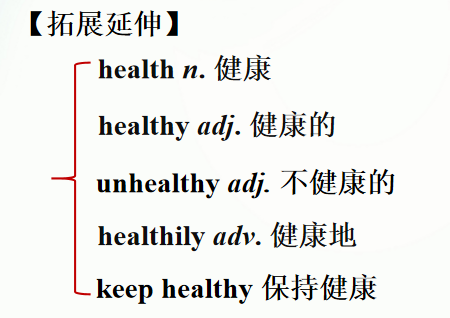
- health n. 健康;人的身体(或精神)状态 作不可数名词,常用短语:be in good/poor health身体好/差。
| | Step 4 Summary & Homework
| The homework can vary with the specific conditions.
| - Summary The T can encourage Ss to summarize the key points of this class to help Ss consolidate the knowledge.
- Preview the passage in Section B 2b.
- Do the exercises in students’ book.
| | Teaching Reflection
| The design of activities before listening(Activities1a and 1b) is very important. The purpose is to activate the memory in students' brain, recall the learned words, phrases and sentence patterns, and pave the way for listening activities. At the same time, students' response process is also to learn and consolidate language knowledge in application. The role of teachers in this link is also very important. They should be good at providing topics and mastering the rhythm and difficulty levels of the discussion and adjusting the discussion atmosphere. We should not only encourage excellent students to express actively, but also pay attention to the students with average or weak foundation and give them the opportunity to express, even if they are just asked to repeat the statements of other students or express whether they agree with others. Teachers should also purposefully pre-teach the unfamiliar words possibly appearing in 1c-1d.
In addition, the demonstration of teachers' language is extremely important. The wording should be concise, clear and easy to understand, which is also an important language information input.
|
|
|
 川公网安备51152402000101号 )|网站地图


 发表于 2026-3-4 02:26:17