|
|
Unit 8It must belong to Clara.
Section A(1a-1c)
Teaching Aims
| 1. Students can make inference using must, might, could and can’t.
whose, truck, picnic, rabbit
1. It must be Carla’s. She loves volleyball.
2. It must be Mary’s. J.K Rowling is her favorite writer.
| Teaching Difficulties
| Use must / could / might / can’t to make inferences.
| Teaching Aids
| multimedia courseware or other realia that the T needs for teaching
|
Teaching Procedures
| Tips
| Step 1 Warming up
| | - First, T shows the picture of an item to Ss. Then, T shows the pictures of two different people. Ask Ss to make inference about who this thing belongs to. (PPT P6-P9)
(Tip: T can encourage Ss to make inference using different sentence structures, such as It must be … / They belong to … / It could belong to … / They might belong to … T also need to encourage Ss to explain the reason why they make such inferences.)
| | Step 2Presentation & Practice
| | Pre-listening
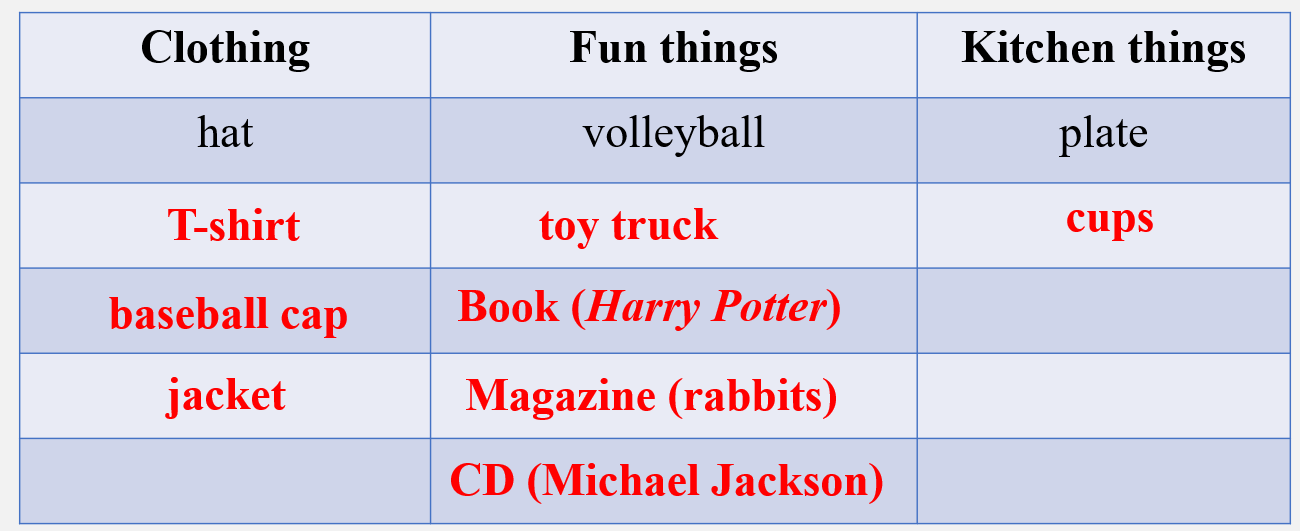
Show the picture of 1a to Ss. Ask them to look at the picture and tell their partners the things they can see.
1a
- Ask Ss to look at the picture, write things they see in the correct columns in the chart.
Answers:
While-listening
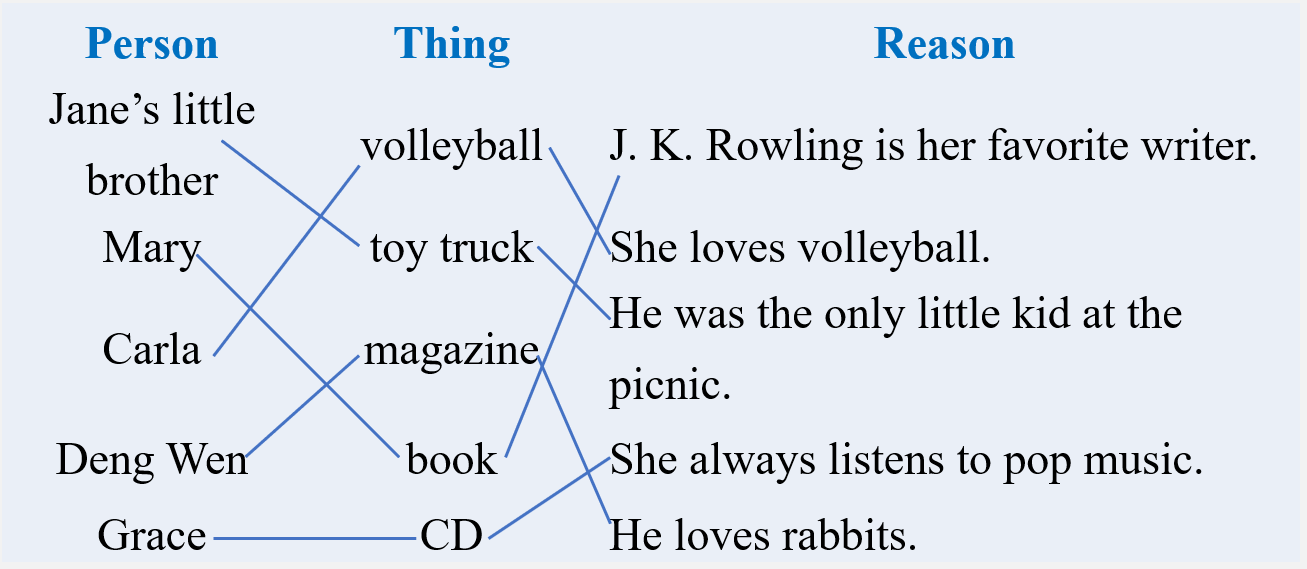
- Before listen to the recording, show the chart of 1b to Ss. Ask them to read the chart and infer who these things belong to.
(Tip: T should focus on the modal verb that Ss use and the reason that Ss given.)
1b
- Play the recording, ask Ss to listen and match each person with a thing and a reason.
Answers:
Post-listening
1c
- Ask Ss to practice the conversation in the picture. Then make
conversations using the information in 1b.
(Tip: To ensure that each S has an opportunity to ask and answer, tell Ss that they should decide beforehand, in their pairs, which two items each two will ask about. They should each ask two questions and answer two questions.)
Optional Choice:
Step 1: T prepares a small box.
Step 2: T asks each S to put an item into the box.
Step 3: T picks one item from the box randomly and asks Ss “Whose … is this?”
(Tip: If necessary, T can show the sample conversation to Ss and tell them that they need to do this activity using the sample sentences.)
| | Step 3Language points learning
| | belong to的意思是“属于”,其中belong是不及物动词,to是介词, 其后一般接名词或人称代词的宾格形式,没有被动语态。
① belong to后面不能接名词性物主代词和名词所有格形式。
② belong to不能用于进行时态和被动语态。
③ belong to的主语通常是物。
whose是who的所有格形式,用来对物主代词及名词所有格进行提问。whose可作定语从句的引导词,在定语从句中作定语。
must可以表示命令,意思是“必须”;也可表示推测,意思是“一定”,用于肯定的推测。must引导的一般疑问句,肯定回答用must,否定回答用needn’t / don ’t have to。
must与have to的区别在于:
must表示主观上认为有义务,有必要;have to着重表示客观上的需要。don’t have to表示“不必”。
| | Step 4 Summary & Homework
|
| Summary
- Ask Ss to do the exercises from PPT P25-26.
Homework:
- Preview the conversation in 2d.
- Do the exercises in students’ book.
| | Teaching Reflection
| This is the first period of the unit. The most important thing is to get the students to learn and practice making inference. We use real things to help practice speaking and make language situation for the students to learn and practice the target languages. We’d better teach new words and structures while listening,speaking and reading. We should learn the modal verbs by comparing them and getting the students to say them out.
|
|
|
 川公网安备51152402000101号 )|网站地图


 发表于 2026-3-6 03:35:54