|
|
Unit 1 How can we become good learners?
第1 课时SectionA(la 〜2d)
【学习目标】
类别
| 学习重点
| 重点单词
| textbook, aloud, pronunciation, sentence ,patient, conversation
| 重点短语
| ask sb for help,have conversations,give a report,speaking skills,get the main i- deas,read word by word
| 重点句式
| - How do you study for a test?
- What about reading aloud to practice pronunciation?
|
【课堂导学案】
Step1 情景导入(5分钟)
T :English is widely used all over the world. But it?s not easy to learn English well for us, because we have no chances to speak English with foreign people. But where there is a will there is a way. If we keep on speaking and using it,we can learn it well.
Questions :
T : Can you tell me how you learn English?
Ss:
- 1 learn English by listening to the tapes.
- 1 learn English by reading aloud.
环节说明:通过和学生的对话引导出新课的中心语句“Howdo you study for a test?”。
Step 2完成教材la〜2d教学任务
1. 通过实物如生词卡、课本、磁带等练习句式:
—How do you study for a test?
—I study by... (3 分钟)
- 小组练习,让学生借助la中的信息使用新知识练习对话,并展示几组学生的对话。(4分钟)
4.检查答案,先要求全班一起给出答案并检查讨论。然后要求2〜3名同学就“What are theother ways you sometimes study?”给出自己的答案,并把收集的答案列举在黑板上。(3分钟)
【参考案例】
Teacher :What are the other ways you sometimes study? Students : I study English .
- by reading English newspapers
- by going over exercises books
……
- 听2a录音第一遍让学生选出所听到的问题。(2分钟)
- 再听录音,让学生跟读并使2b答句与2a中问题相匹配。(3分钟)
7. 要求学生根据所听到的内容完成下列各句。完 成后要求若干学生给出自己的答案。以巩固对听力内容的了解。(4分钟)
- The children are talking about the best ways to learn English.
- —Do you learn English by watching English videos? —No. It’s too hard to understand the spoken English.
- — What about listening to tapes?
—I do that sometimes. I think it helps.
(4)—Do you have conversations with friends in English?
—Oh,yes. It really improves my speaking skills. (5)—Have you ever studied with a group?
—Yes,I have. I’ve learned a lot that way.
8.小组练习,让学生结合2a、2b中的信息编对话, 练习新句型:
—Have you ever studied with a group?
—Yes,I have, I’ve learned a lot that way. (5 分
钟)
9.对话内容巩固训练。要求学生根据2d对话的内容完成下列各句。完成后要求若干学生给出自己的答案。以巩固对对话内容的了解。(4分钟)
- Jack is a little nervous because he has to finish reading a book and giving a report next Monday.
一No,he’s a very slow reader.
- 一How does Annie read? Does she read word by
word?
一She reads quickly to get the main ideas at first. She doesn’t read word by word. She reads word groups.
- We needn’t use a dictionary to look up every new word we meet when we are reading.
- Sometimes we can guess the meaning of a new word by reading the sentences before and after it.
(B )(1) 一 do you study for a test?
一I study by working with a group.
C. Why D. Who
(D )(2)—How do you study Chinese so well?
一 reading plenty of books.
C. At D. By
环节说明:听说结合,第一时间向学生传达语言目
标,通过结对对话和小结训练,使语言目标得以强化。
Step 3问题探究(5分钟)
根据汉语提示完成句子。
1.I study English by making (制作)the word
Cards.
2. What about reading (阅读)quickly to get the main ideas?
3. 顺便说一下,你晚8点之前必须回来。
By the way,you must come back before 8:
00 p. m.
4. 一年内学好英语对我来说太难了。
It’s too hard for me tolearn English
well in a year.
5.你吃得越多,你会越胖 。
The more you eat, the fatteryou
will be.
【课后作业案】
完成本书课后提升案对应练习。
- 熟读3a,试着让学生简单地复述3a的内容。 (5分钟)
( C ) (1) I discovered that somethinginterestingis the secret to language learning.
( D )(2)I in a dictionary.
( B ) (3) Learn auseful sentence like “It’s a piece of cake. ” by the movies.
根据句意及首字母提示完成句子。
(1) Which c haracterdo you like most in that
movie?
(2)We have many expressionsto show our
friendship to others.
(3)If you do this,you’ll find the secret to solve
all the problems like that.
(4)I don’t like learning English grammar . It’s too boring.
Step 4完成教材4a〜4b教学任务
- 学生用4b方框中的词造句,使用句式by doing sth.。(6 分钟)
- 让学生先根据自己学习英语的情况完成调查表左半栏内容,再运用所学句型向学生做调查完成右半栏内容。(4分钟)
- 找三到四名学生用英语表述自己的调查情况。(5分钟)
5.小结训练。要求学生在规定的时间内完成一个 小练习。并请若干学生给出自己的答案。有错误的话及时纠正。(2分钟)
根据汉语意思完成英语句子,每空一词。
⑴自从我听了这门课,我的写作技能提高了很多。
My writing skills have improved a lot since I took the class.
It’s very important to take notes in class.
I think the bestway to learnEnglish is to use it often.
Listening to Englishmore is very important.
How /What about watchinganEnglishlanguage movie with me now?
环节说明:学会语言的标志就是能使用语言。让学生运用所学语言去交流,不仅能巩固所学知识,也能 锻炼学生口语表达能力。
Step 5问题探究(4分钟)
(D ) 1. Who America?
C. found out D. discovered
( C )2. He is a teacher,and he is a scientist .
C. as well D. as well as
- He is too old,he can’t work any longer•(合为一句)
He is so old that he can’t work any lon
ger.
- He comes here in order to see the star•(改为复合
句)
He comes here so that he can see the star ..
【课后作业案】
完成本书课后提升案对应练习。
第 3 课时 SectionB(la〜2e)
【参考案例】
【学习目标】
类别
| 学习重点
| 重点单词
| Pronounce, increase, partner,speed , ability, create, wisely ,born ,knowledge
| 重点短语
| spoken English , make mistakes in..., writing practice , join a club , pay attention to , c onnect-…with , depend on, be born with..
| 重点句式
| - He can’t get the pronunciation right.
- I don’t know how to increase my reading speed.
- He succeeded by trying many times and learning from his mistakes.
- Even if you learn something well , you will forget it unless you use it.
|
【课堂导学案】
Step l复习(2分钟)
l.复述P3 3a第2段。
2.用by造句。
Step 2情景导入(2分钟)
T :Do you remember the ways of learning English that we’Ve learned in Section A? Maybe you have many good ways to learn English, but have you ever had any problems with English?
Now,let’s look at la and check the statements that are true for you. (4分钟)
Look at lb. What other things are difficult for you? Make a list. (2分钟)
环节说明:通过几个问题引导学生回答一些学习中的困难,然后导入新课。
Step 3完成教材la〜2e教学任务
1.要求学生翻开课本P5,迅速阅读la部分的内 容。并按要求完成课本上相应的任务。然后要求5〜 8名同学给出自己的答案,教师可把这些问题在黑板上列举出来并进行一下排序,看哪个问题是最多同学碰到的。(3分钟)
I can’t pronounce some of the words.
| 2
| I can’t understand spoken English.
| 3
| I don’t know how to increase my reading speed
| l
| I can’t spell some English words.
| 2
| I often make mistakes in grammar.
| 5
|
- 小组练习。让学生借助lc〜ld的信息分角色 扮演来练习对话,并找三到四对学生展示他们的对话。 (6分钟)
- 学生快速默读短文,熟知大意,并完成课本2a 的任务。然后邀请几位同学给出自己的答案,全班一 起检查讨论。(3分钟)
7. 先邀请几位同学阅读短文(可一人一段),教师要注意语音,及时纠正。然后播放录音,全班同学一起 跟读。(3分钟)
8短文内容巩固练习。教师可给出一篇改写了的短文,将一些重点的表达方式空出。让学生在规定的时间内补全短文。然后邀请若干同学给出自己的答案。(4分钟)
My English class was difficult last year. To begin with,the teacher spoke too quickly to understand every word. Later on,I was afraid to speak English in class, because I thought my classmates might laughat me. I couldn’t. make complete sentences, either. Then watching English — language TV gave me lots of help. I think becoming a good language learner’s secret is to do lots of listening practice. At the same time,I found English grammar to be difi- cult,too. So I took many grammar notes in English class. I used the grammar to write my own original sentences. It’s amazing how much this helped. Now I like learning English. I got an A this term. My English teacher is very impressed.
| 9.小结训练。(3分钟)
| | (
| C
| )(1)I can’t understand
| English.
| | | A. speak
| B. speaking
| | | C. spoken
| D. speaks
| (
| A
| )(2) I make mistakes
| grammar.
| | | A. in
| B. of
| | | C on
| D. about
| (
| A
| )⑶He can’t get
| |
环节说明:听说结合,第一时间向学生传达语言目标,通过结对对话练习和小结训练,使目标语言得以巩固。
Step4问题探究(3分钟)
(B )1.—I our school football team last
Year.
—You mean you the last month’s
football game.
B.joined; took part in
C took part in; joined
D. took part in;took part in (C ) 2. I don’t know .
- how can I solve the problem
- how I could solve the problem
(D ) 3. I don’t have a partner .
- to practice English with 【课后作业案】
完成本书课后提升案对应练习。
第 4 课时Section B(3a〜Self Check)
【学习目标】
类别
| 学习重点
| 重点单词
| Act active,brain
| 重点短语
| be interested in,learn English by listening to- ,take notes,worry about
| 重点句式
| 1. If you like music,you can learn English by listening to English songs.
- 2. 2.Well, I practice my listening by listening to the tape over and over again until I can understand everything.
- I 3.have a listening test next week.
|
【课堂导学案】
Step1复习(3分钟)
让学生用pronounce,spoken,make mistakes 造句。 Step2情景导入(3分钟)
T:If we want to be a successful learner, good learning habits are very important. Do you have any good learning habits? What are they? Then let’s read the passage and let us seewhat good learning habits the successful learners have?
环节说明:让学生一起讨论提高英语学习的方法。
Step 3 完成教材3a〜SelfCheck教学任务
1.让学生讨论完成表格的内容。(10分钟)
- 核对答案,并根据学生讨论情况,写出更多的学习 英语的方法。(3分钟)
- 告诉学生说,你的一个朋友要你帮他提升英语 技能,你可以给他介绍三个方法。同时每个方法还要解释一下原因,同时给出一个例子。然后根据3a的表 格的提示写一个提要,然后与同学们进行交流。(5分钟)
4.让学生完成3b练习。(8分钟)
- 让学生分组完成Self Check练习题。(4分钟)
- 要求学生给出自己的建议以帮助下面三个在学习英语中碰到困难的同学,解决他们的问题。要求学 生把各自的建议在班上念出来。(5分钟)
7.小结训练。(3分钟)
(B ) (1)I create in paper cutting.
- interested B. an interest
- interesting D. a interest
( C ) (2) He is afraid questions.
C of asking D. ask
(A )(3)He doesn’t pay attention his bad
habits.
A. to B. of
环节说明:通过练习来加强学生的理解,使所学语
言得到了及时的运用。
Step 4问题探究
( B )(l)If you are in something, your
brain will be more active.
A. interest B. interested
C. interesting D. interests
( B ) (2)If you like music, you can learn Englishby English songs.
(A) (3) Remember to in class and re-
view them on your own or with friends after class.
A. take notes B. write
【课后作业案】
完成本书课后提升案对应练习。
Unit 2 I think that mooncakes are delicious!第l 课时Section A(la〜2d)
【学习目标】
类别
| 学习重点
| 重点单词
| stranger, relative, pound
| 重点短语
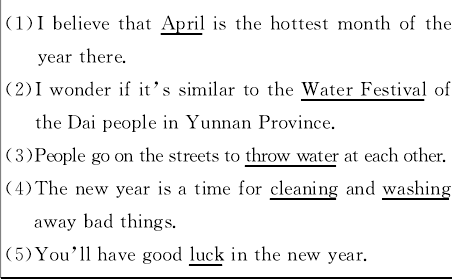
| be back, put on, eat out, in two weeks, be similar to,throw. . . at,wash away
| 重点句式
| - I guess it was a little too crowded.
- Bill wonders if/whether they’ll have zongzi again next year.
- I believe that April is the hottest month of the year there.
- Because the New Year is a time for cleaning and washing away bad things.
|
【课堂导学案】
Step l复习(4分钟)
2.两位学生读自己上课时所写的作文。
3.教师点评。
Step 2情景导入(3分钟)
 T: We know China has some traditional festivals, such as the Spring Festival,the Dragon Boat Festival, Mid-Autumn Festival, the Lantern Festival and so on. Which festival do you like? Why? What can you do in these festivals? Now let’s look at la and match the pictures with the descriptions.
环节说明:通过几个问题引导学生对节日的了解。
J
Step 3完成教材la〜2d教学任务
—What do you like best about. . . ?
—I love. . . I think...
4. 再听录音完成2b练习。(2分钟)
- 检查答案,要求全班一起给出答案并检查讨论。 (3分钟)
- 结合2a、2b的部分信息,让学生分组练习对话。 注意要使用that引导的宾语从句。(7分钟)
【参考案例】
A :What did you do on your vacation?
B:I went to Hong Kong. I think that...
①bought very beautiful clothes.
②I ate different food.
7.让学生读2d对话然后表演。(lO分钟)
8.播放2d的对话录音,让学生跟读,模仿并理解大意。然后让学生分角色朗读并表演2d的对话。(5分钟)
9.对话内容巩固训练。要求学生根据2d的对话 内容完成下列各句。完成后要求若干学生给出自己的答案。以巩固对对话内容的了解。(4分钟)
10.小结训练。(2分钟)
( B )(1)I think he will come soon.
A. what B. that C. which D. if
(C )(2)He is fat now. He 10 pounds.
A. puts up B. put on
C. has put on D. has put up
 环节说明:将听、说、读、写任务集合起来,不仅锻 炼了学生的语言综合运用能力,还巩固了学生对目标语言的学习、识记和运用。
Step 4问题探究(3分钟)
根据汉语提示完成句子。
1.那故事听起来有趣。
The story sounds like fun .
I don’t know if/whether he will go to Beijing.
We will be in another school in a year.
【课后作业案】
完成本书课后提升案对应练习。
第 2 课时Section A(3a〜4c)
【学习目标】
类别
| 学习重点
| 重点单词
| Ste steal , lay, dessert, garden, admire, tie
| 重点短语
| in the shape of,shoot down,fly up to, call out . . . to,lay out,admire the moon,share sth. with. ..,as a result
| 重点句式
| - 1.However, most people think that the story of Chang’e is the most touching.
- W 2.Whoever drank this could live forever.
- H 3.How he wished that Chang’e could come back!
- P 4.People started the tradition of admiring the moon and sharing mooncakes with their families.
- T5. They carry people’s wishes to the families they love and miss.
|
【课堂导学案】
Step 1复习(2分钟)
回答问题:1. What do you think of the race of the Dragon Boat Festival?
- What do you think people eat in the Spring Festival?
Step 2情景导入(2分钟)
T : Last class we learned about the Dragon Boat Festival. Today I will learn about Mid-Autumn Festival. Who can tell me when Mid-Autumn Festival take place and how people celebrate Mid-Autumn Festival?
通过多媒体向学生展示一组中秋节的图片,如满月、月饼,嫦娥等或一段嫦娥奔月的动画,借机向学生提问::
Do you know what festival it is? And what is the story about this festival?展示图片,学生讨论,导入生词和短语。本课时的主要内容是一篇小短文,在学习短文之前教师可准备几个与短文内容相关的问题,然后邀请几位同学就提出的问题给出自己的答案或见解。(4分钟)
Questions :
1. How do people celebrate Mid—Autumn Festival?
2. What story is the reading about?
环节说明:结合学生对节日的了解通过几个问句来引入新课,让学生的注意力集中在如何庆祝中秋节上,也使学生非常渴望知道有关知识。
Step 3完成教材3a〜3c教学任务
1.先邀请几位同学阅读短文(可一人一段),教师
要注意语音,及时纠正 。然后播放录音,全班同学一起
跟读。(3分钟)
2.学生熟读3a短文,完成3b、3c作业。(10分钟)
3.短文内容巩固练习。教师可给出一篇改写了的短文,将一些重点的表达方式空出。让学生在规定的时间内补全短文。然后邀请若干同学给出自己的答案。(4分钟)
Long long ago, there were ten suns in the sky, people
Couldn’t stand them. At last a brave man called Hou Yi shut down nine of them. A goddess gave him two magic pills to thank him Whoever drank this could live forever. Hou Yi planned to drank them with his beautiful
wife,Chang’e,but Chang’e drank both of pills while Hou Yi was away. She became very light and flew to the moon. Hou Yi was sad and he laid out her favorite fruits and desserts in the garden on each full bright moon night so that he hoped his wife could come back. After that,people in China started the tradition of admiring the moon and sharing mooncakes with their families.
4.让学生展示阅读情况,校对3b、3c的答案。(4分钟)
- 根据学生完成练习情况对3a短文进行适当的 讲解。(6分钟)
(
| B
| )(1)Give my best
| to your mother.
| | | A. wish B. wishes C. wishing
| (
| D
| )(2)he is,I want to see him/her.
| | | A Who
| B. Where
| | | C. When
| D. Whoever
| (
| C
| )(3) He wished that he
| fly to the moon.
| | | A. can
| B. will
| | | C could
| D must
|
环节说明:通过短文阅读及完成练习来加强学生 从短文中获取信息的能力,用练习来巩固新的语言点。
Step 4完成教材4a〜4c教学任务
1.让学生看语法精讲部分,教师作适当点拨。 (2分钟)
2.独立作业4a、4b。(5分钟)
3.以小组为单位作调查,然后报告给全班(注意使用句式: X X X ’s favorite festival is. . . He thinks that. .. )。(5分钟)
4要求学生翻开课本P12,用4a中所给的单词造句。要求五位同学分别把答案写在黑板上。(3分钟)
- 1 don’t know whether he will come home for the
Festival.
- 1 believe that Water Festival has the most fun.
- 1 wonder if the mooncakes are delicious.
- How exciting the races are!
- What interesting city (it is) !
环节说明:学会语言的标志就是能使用语言,让学生 用所学的知识来交流,既能锻炼口语,又能巩固所学知识。
Step 5问题探究(3分钟)
(B )1. He you to take part in the celebration
Activity.
(D )2. —Where are the other suns?
—Hou Yi .
(B )3. The boy refused a room w i t h me.
C. sharing D. to sharing
( B )4. he wished he could come back!
A. What B. How
C. Whether D. Whenever
【课后作业案】
完成本书课后提升案对应练习。
第 3 课时 SectionB(la〜2e)
【学习目标】
类别
| 学习重点
| 重点单词
| scary,ghost,spider,probably,importance ,warn, punish, Christmas
| 重点短语
| trick or treat,dress up,play a trick on, turn off,learn about,light candles, think of,the spirit of christmas
| 重点句式
| - 1.What do you like most about this festival?
- 2.I think it’s fun to dress up as cartoon characters!
- 3.But behind all these things lies the true meaning of Christmas: the importance of sharing and giving love and joy to people around us.
- e 4.He now treats everyone with kindness and warmth, spreading love and joy everywhere he goes.
|
【课堂导学案】
Step l复习(3分钟)
l复述嫦娥的故事。
Do you know? Do Chinese people celebrate Christ- mas?(改为宾语从句)
Step 2情景导入(2分钟)
T:We know some Chinese traditional festivals. However, do you know about Western festivals,such as Halloween,East- er and so on? Who can tell me anything about Hallowen?
环节说明:因为学生对万圣节不很了解,所以学生带着问题去听,注意力更集中。
Step 3完成教材la〜2e教学任务
l鼓励学生根据图片和方框中所给的单词,试着 介绍万圣节是关于什么的。(5分钟)
4.校对答案并解释重点短语dress up as和play a trick on,并用其造句。(3分钟)
如:The boy dressed up as a Father Christmas on Christmas.
The old man likes playing a trick on young people.
- 再听录音,讨论最使你感兴趣的万圣节活动。 (1分钟)
7.小结训练。(2分钟)
( A )( l) People usually candles on their
birthdays.
A. light B. lighted
C. lit D. lighting
( B ) (2) He dresses up a ghost to look
scary.
A. in B. as C. with D. on
( D ) (3) “Trickor treat’’means kids will play atrick
you if you don’t give thema treat.
A. to B. with C. for D. on
短文内容巩固练习。教师可给出一篇改写了的短文,将一些重点的表达方式空出。让学生在规定的时 间内补全短文。然后邀请若干同学给出自己的答案。 (4分钟)
Christmas Day, the 25th of December ,is the
biggest festival celebrated in the Christian countries of the world. Although everyone enjoys Christmas Day,it is particularly enjoyed bychildren ,who
get very excited because of the presents. Small
children believe that their presents are brought
by Father Christmas. Father Christmas is a kind of old man who lives at the North Pole. He travels through the sky on a sleigh(雪橋)which is pulled by reindeers (马川鹿)and filled with presents. Stopping on the roof of houses, he enters byclimbingthechimney(烟函)• When small children go to bed on Christmas Eve,thehang astocking at the end of their beds.
When they wake, they find their stockings filled withpresents . Christmas is also a family celebra-
tion. As any members of the family as possible gather to eat, play party games and watch thespecial Christmas programs on TV.
环节说明:听说结合,第一时间向学生传达语言目标,通过结对对话及小结训练,使目标语言得以巩固。
Step 4 问题探究(4分钟)
根据汉语提示完成句子。
1.他今天穿着大衣。
He is wearing a coat today.
I dressed my daughterin a T-shirt today.
It’s fun to dress up as cartoon
characters.
4她总是捉弄别人。
She always play a trick on others.
选用方框中所给单词的适当形式补全对话。
part , believe,color,treat , holiday , longer, symbol,play,do,from
Ann: Can you tell me what is the Halloween?
Lily : Halloween is a 1 celebrated on October 31
Long ago,people 2 that witches gathered
together and ghosts hung out around the world on Halloween. Today,most people no 3 believe in ghosts and witches.
Ann: What are the main 4 in Halloween?
Lily: The main colors black and orange are also a 5 of Halloween. Black is a 6for night
and orange is the color of pumpkins.
Ann: What do the children 7 in Halloween?
Lily: Once in costume, children go 8 house to
house saying “Trickor treat” ! Children might
9a “trick” on people if they do not give
10, 1 ike pelting houses with eggs or old tomatoes or crying for the candies.
1. holiday 2. believed 3. longer 4. colors 5. part
6. from 7. do 8. play 9. play 10 treats
【课后作业案】
完成本书课后提升案对应练习。
第 4 课时Section B(3a〜Self Check)
【学习目标】
类别
| 学习重点
| 重点单词
| festival,introduce,explain
| 重点短语
| the name of……, talk about, celebrated in/on…
| 重点句式
| 1.First,introduce the festival and when it is celebrated.
- Then talk about what people do and eat.
- Finally, explain why you like it best and how it makes you feel.
|
【课堂导学案】
Step 1复习(1分钟)
让两位学生谈论Halloween。
Step 2完成教材3a〜SelfCheck教学任务
1.回答表格中所提的问题。(5分钟)
2.运用3b中的expressions给你的笔友写一封信。(8分钟)
- 教师让学生读自己的作文,教师点评然后给出范文。 4完成Self Check练习题。(10分钟)
5.小结训练。(4分钟)
(B ) (1) He can understand the of sha
ring and giving love and joy to people.
A important B. importance C. necessary
(C)(2) The novel is by Charles Dick
ens.
A. writing B. wrote
C.writen D.writes
( A ) (3)Don’t be afraid. It is a dog.
A. dead B. die C. death D. died
(D )(4)The teacher warns me the same
mistakes again.
A. don’t make B. not make
C. not make D. not to make
环节说明:通过练习来加强学生的理解,使所学语言得到及时的运用。
Step 3问题探究(5分钟)
(B )1. What’s the by saying so?
C. means D. meant
(C )2. The old man is . He never gives
anything to others .
C. mean D. meant
( D )3. A man cant come back to life.
A. death B. die
C. dying D. dead
(A )4. Our parents are the first people to give us love and .
A. warmth B. warm C. kind
(B )5. The boy ended school because he
always caused trouble.
A. leave B. up leaving
C. up to leave D. up leave
根据句意及首字母提 示完成句子。
1. It is said that it is a haunted house because
some people met a ghost there.
- Tina’ s mother was teaching her how to treat the guests politely.
3. Have you ever read the short novel called A
Christmas Carol?
4. As we know, the sun gives us the light and the
warmth .
5. Santa Claus gives gifts and spreads love and
joy to everyone wherever he goes.
【课后作业案】
完成本书课后提升案对应练习。
第1 课时Section A(la〜2d)
【学习目标】
类别
| 学习重点
| 重点单词
| restroom, stamp, beside, postcard, pardon ,bathroom, rush
| 重点短语
| on your left, turn left, go/walk past, be used in, Animal World
| 重点句式
| 1 Could you please tell me where the restrooms are?
- Could you please tell me how to get to the books tore?
- I wonder when the park closes today.
|
【课堂导学案】
Step 1复习(1分钟)
谈论自己最喜欢的节日及其原因。
Step 2情景导入(4分钟)
T :Do you know how to ask for help politely
when you don’t know where togo? You may say: Where is the. . . . ? Is it right? But it’s an impolite way to ask for help. Who can ask for help politely?
Let’s listen to him.
Questions :
T : Can you tell me how to ask for help?
Ss:Sure.
T : Please tell us.
SA:
- Excuse me,could you t ell me where the bank is?
- Excuse me,could you tell me how to get to the bank?
⑶…
SB : Sure,there is. . . /go to...
环节说明:通过师生对话引导学生进入本课时的 中心句:“Excuse me,could you tell me... ”。
Step 3完成教材la〜2d教学任务
1.根据图片完成la的图片和文字的搭配。 (1分钟)
2.听录音,完成会话中的填空。(2分钟)
- 根据la中的信息编造对话,注意使用表示询问 的含有宾语从句的句子及其回答。(5分钟)
【参考案例】
A:Excuse me,could you tell me !
B: Sure, (l)just go along...
A: Thanks . Do you know when. . . closes/opens today?
B:It closes/opens ...
4.听录音完成2a。(2分钟)
7.会话表演:先读2d的对话,然后让两组表演对 话。(10分钟)
8.教师根据情况提示重点知识点。如:pardon, rush等词。(2分钟)
9.小结训练。(3分钟)
(C )(1) Could you tell me ? I want to change
money
B. how can I get to the bank
C. whether there is a bank near here
(B )(2) —Could you tell me where the store is?
— ?
A. Excuse me B. Pardon me C. Sorry
( B ) ( 3) —Excuse me,do you know if there is a library near here?
— . Go down this street and turn
right at the second crossing.
A. Yes,I do B. Sure C.No,I don’t
Step 4问题探究(3分钟)
(C ) 1. Go along the street and go the
bank,you will find the post office.
A. across B. through
C. past D. pass
( A )2. , please repeat it again.
( B )3. Did you hear the latest this morning?
A. informations[来源:Z&xx&k.Com]
B.news
C. messages
用方框中所给的适当句子完成对话(有两项多余)。
A: Excuse me! Could you please tell me where there is a good place to eat?
B: 1. G ! There are many good restaurants here, what food do you like to eat?
A: I like Italian food.
B: We have two Italian restaurants. One is on the Main Street,named Green Land. 2. F ,called Sally’s.
A:3. C ?
B: Sally. is a little nearer but it. expensive. Green Land is farther but the food is both delicious and
cheap.
A: Let’s go to Green land! But4B ?
B: Go down the street and turn left at the third crossing. Then you will be on the Main Street. You will see Green Land is between the post office and Milly’s Cafe.
A: 5. E !
- The other is next to the movie theatre
【课后作业案】
完成本书课后提升案对应练习。
第 2 课时 SectionA(3a〜4c)
【学习目标】
类别
| 学习重点
| 重点单词
| suggest,grape,central,mail,east
| 重点短语
| come on, at first, pass by, walk up to, pardon me,the shopping center
| 重点句式
| - I wonder where I should go next.
- It seems a rock band plays there every evening.
- Excuse me,can you tell me how I can get to a nearby restaurant?
- Pardon me,do you know if there’s a restaurant around here?
|
【课堂导学案】
Step 1复习(2分钟)
选择当地某一个地方或单位进行对话。
how I can .. ?
如:一Excuse me, could you tell me{where I can . . ?
if there is…?
一Sure,...
Step 2情景导入(3分钟)
T:Everyone may have been to some parks, Water World,some zoos. Do you think they are fun? Have you been to Fun Times Park? It’s really a wonderful park. Do you know about it?
环节说明:调动学生的积极性,让学生有一个极其想了解“Fun Times Park”的欲望,这样学习效果更佳。
Step 3完成教材3a〜3b教学任务
1让学生快速读3a并回答短文前面的两个问题。 (8分钟)
2.再读,找出询问信息的句子,然后改写为另一种表达方式(即含有do you know/could you tell me 的句式)。(10分钟)
如:Doyou know where we can get some good food quickly?
→Could you tell me where we can get some good food quickly?
按要求完成下列各题。
(1)Do you want to go to Water World now? Can you tell me?(改为宾语从句)
Can you tell me if you want to go to
Water World?
(2)我建议我们去Tom叔叔的餐馆。(汉译英)
I suggest wewill go toUncleTom’s.
(3)我们从水上公园路过。(汉译英)
We passed by Water Park.
环节说明:读写结合,加强学生从短文中获取有效 信息的能力,及时巩固所学语言点。
Step 4完成教材Grammar Focus〜4c教学任务
1.教师让学生归纳本单元语法结构:Can/Could you tell me ..? Do you know. ••?(从句要用陈述句形式)(3分钟)
环节说明:对本单元的语法知识进行归纳梳理,让学生对语法知识及时得到巩固。
Step 5问题探究(2分钟)
(B ) 1. Ben is wondering there is a shopping
center near here.
A. that B. if
C.when D=how
(A ) 2. Could you please tell me get to
the post office?
A. how to B. how can I
C. how could I D. how I could
句型转换,每空一词。
- Could you tell me how I can get to Tibet?(改为同义
句)
Could you tell me theway to Tibet?
- Is Chen Shuibian still in the prison?(改为宾语从句)
Could you please tell me if/whether Chen
Shuibian is still in the prison?
- Where can I buy any stamps? Do you know?(合并句子)
Do you know where I can by any
stamps?
- He likes going to Watertown. I like going to Watertown,too.(改为同义句)
Both he andI likegoing to
Watertown.
- Could you tell me where I can get something to eat? (改为同义句)
Could you tell me where to get something
to eat?
【课后作业案】
完成本书课后提升案对应练习。
第 3 课时 Section B(la〜2e)
【学习目标】
类别
| 学习重点
| 重点单词
| convenient, comer, politely, request, direction, correct, polite, direct, indirect, speaker, whom, impolite,address,underground,course
| 重点短语
| go to the corner, a place to eat, request for directions, depend on, lead in to, a parking lot, in different situation, ask for,any other language
| 重点句式
| - T 1.The clerk tells her to go to the corner of Market and Middle Streets.
- C 2.Can you tell me where there’s a good place to eat?
- 3.We also need to learn how to be polite by being less dirett or more indirect— when we ask for help.
- T 4.The expressions they use might depend on whom they are speaking to or how well they know each other.
|
【课堂导学案】
Step l复习(1分钟)
根据下列图示编造对话。
Step 2情景导入(2分钟)
T :Think about there are some restaurants, museums, parks and malls in your neighborhood. What do you think of them? Can you describe them?
环节说明:提问使学生回顾所学的形容词,为新课做准备。
Step 3完成教材la〜2e教学任务
1.要求学生翻开课本P21,迅速浏览la部分方框中的单词及右边的表格内容。看一看对每一个地方要有什么重要的品质并把相应 的单词写在表格中每个地方相对应的表格中。(3分钟)
Places
| Qualities
| (l) restroom
| clean, big
| (2) museum
| interesting, beautiful
| (3) restaurant
| inexpensive, delicious
| (4)park
| beautiful,fascinating
| (5) subway
| safe, convenient
| (6) mall
| big,uncrowded
|
2.先让两位学生分角色朗读lb方框中的对话。 然后让学生两人一组仿照对话,编一个谈论自己城市的对话。然后在班上演示。(3分钟)
3.让学生快速浏览lc方框中的句子,要求学生听第一遍录音,让学生只是听,了解大意,听第二遍录音,完成课本上lc部分的任务。在播放录音前,要求学生抓住要点,并注意一些听写技巧。核对答案时,要求学生先读出要填写的单词,然后读出完整的句子。(3分钟)
4.要求学生听第三遍录音,让学生跟读对话,并核对答案,完成ld的任务。(3分钟)
5.先让两位学生分角色朗读le方框中的对话。 然后让学生两人一组仿照对话,编一个类似的对话,然后在班上演示,完成le的任务。(3分钟)
6.要求学生快速默读短文,熟知大意,然后邀请几
位同学给出自己的答案,全班一起检查讨论。(3分钟)
7.先邀请几位同学阅读短文(可一人一段),教师要注意语音,及时纠正。然后播放录音,全班同学一起跟读。(3分钟)
11小结训练。(分钟)
(B ) (1) Can you tell me there’s a place !
- where; to take a bus C if;by bus
C ) (2) He tells me the zoo.
C.not to go to
Step 4问题探究(2分钟)
( C )1. He is busy.
A. kind B. a kind of
C ) 2. I have a place .
A. eat B. eating
C. to eat D. ate
根据句意及汉语提示完成句子。
1.The flowers in the park were so fascinating (迷 人的)that we took many photos there.
2.Thanks to the Internet,it is more convenient (便利的)to get information about the world.
3. There are too many people in the mall (商场) during the festival.
4. My sister works as a clerk (职员)in a bank.
5. The old man asked the boy to stand in the corner (角落)of the room*
【课后作业案】
完成本书课后提升案对应练习。
第 4 课时Section B(3a〜Self Check)
【学习目标】
类别
| 学习重点
| 重点单词
| Tra travel , study, course, other
| 重点短语
| travel to ...,I’d like to ...,look forward to…,be coming to•••
| 重点句式
| 1 I’ 1.I’m looking forward to your reply.
- 2.Could you tell me where the library is?
- I 3.I want to buy some winter clothes. Could you tell me which place would be a good choice for me to go to?
|
【课堂导学案】
Step 1复习(1分钟)
回答:What do you say if you want to go to the bank and don’t know the way?
Step 2情景导入(2分钟)
T: When we ask for help, we must be polite. How do we ask for information politely? Look at the two sentences,which do you think is more polite?
A:Where are the restrooms?
B: Could you tell me where the restrooms are?
环节说明:通过比较两种句式复习新课,直接明了。
Step 3 完成教材3a〜SelfCheck教学任务
1.完成表格内容。(5分钟)
- 运用所给的expressions,write a polite letter to' the school。(6分钟)
- 教师根据学生的理解情况作一些重难点讲解。 (3分钟)
4.学生独立完成Self Check任务。(5分钟)
5.小结训练。(3分钟)
( C ) (1) He answered my questions . It
made me pleased.
C. politely D. impolitely
(D ) (2) Whether I help him/her or not depend on
he/she is.
A. what B. that
C. whose D. whom
( B )(3) me, could you please tell me where
my car?
环节说明:阅读与练习结合,不仅增强学生获取信息的能力,而且巩固所学知识。
Step 4问题探究(3分钟)
用所给词的适当形式填空。
1.It?s not polite to request for direction directly
(direct).
- The teacher uses a game to lead (lead) in new knowledge.
- Look at the sign:No parking (park).
根据句意及首字母提示完成句子。
1.一What c ourse will you study this term?
一We will learn Chinese, math,and E nglish .
- I want to sent an e — mail to Dave,but I don’t know his e—mail a ddress .
3. In China it‘ s i mpolite to laugh loudly before
others.
4. Thanks to the Internet,now it’s convenient for us to shop online.
5. He looked through the book carefully to find out the c orrectanswer to the question.
Step 3完成教材la〜2d教学任务
1.带领学生快速完成1a练习。(2分钟)
- 练习对话(lc)并编自己的对话(用1a的图片)。 (3分钟)
4.听录音,完成2a、2b练习。(3分钟)
5.结合lb、2b示例及1a部分信息,让学生分组练习对话,注意运用新知识“used to”。(7分钟)
【参考案例】
T :What did you look like five years ago?
Ss:I used to .
6.阅读2d并表演对话。(8分钟)
7.小结训练。(4分钟)
(B )(l)— work in Microsoft?
一No,I didn’t.
- Did you used to B. Did you use to
C. Do you used to D. Do you use to
(A ) (2) Jenny used to .
A. be quiet B. being quiet C. quiet ( C )(3)—How does Jack usually go to school?
一He ride a bike, but now he —
there to lose weight.
- was used to;is usedto walking
- used to;is used to walking
( B ) (4)一Are you “planting vegetables” on
line?
——No,I think it’s awaste of time.
A. major in B. interested in
C. angry with
环节说明:听说结合,更容易让学生掌握新的语言知识。
Step 4问题探究(3分钟)
( A )l. He to be polite.
A. didn’t use B. didn’t used
C. don’t used D. don’t use
( B )2. She used long hair.
A. have B. to have
C. be D. to be
( C )3. She a doctor,but now she
—not.
A. used to;was B. uses to;was
C. used t o be;is D. uses t o;is
【课后作业案】
完成本书课后提升案对应练习。
第 2 课时 SectionA(3a〜4c)
Step 2情景导入
T :Each of us used to be different from now. Maybe we used to be shy, but now we are outgoing. For example,a 19-year-old Asian pop star Candy Wang used to be a shy girl,now she is a pop star. Do you want to learn about her past and present? If you want to do it,let’s read the passage in 3a.
环节说明:此环节的目的是为了引起学生的阅读 兴趣,提高学习效果。
Step 3完成教材3a〜3c教学任务
- 读3a短文,从方框中分别找出3段的中心句。 (5分钟)
- 角色扮演,一个学生作为记者,另一个学生作为 Cindy。记者向Cindy提问。(5分钟)
4.根据学生的理解情况,对3a短文中的重难点进 行解析。(5分钟)
5.小结训练。(3分钟)
(C )(1)How did Cindy her shyness?
A. deal B. deal to
C. deal with D. do to
(B ) (2) A small number of books in Japanese
A. is written B. are written
C. write D. writes
( D )(3)He a teacher.
A. used to not B. didn’t used to
C. used to no t be D. didn’t use to be
环节说明:通过短文阅读和完成练习来加强学生从短文中获取有效信息的能力,并能及时地巩固所学的知识。
Step 4 完成教材Grammar Focus〜4c教学任务
(学生可以参看学生用书同步语法精讲)
(注意:used to的否定句及疑问句形式)
呢?通过多媒体向学生展示一些图片,如凶猛的动物、 黑暗、风暴等,借机向学生提问:“I used tobe afraid of snakes,wha t did you use tobe terrifiedof?”展示图片,引导学生根据表格填写内容并说出句子。(4分钟)
环节说明:通过展示图片,激发学生的学习兴趣和表达欲望;情境的成功创设为生词和短语的教学作了良好的铺垫,可谓“一举两得”。
Step 5问题探究(3分钟)
( C ) 1. Jack is afraid of alone.
( A ) 2. He won’t English .
- give up;anymore B. give up;no more
C. stick to;no longer D. stick to;no more
(D )3. Work harder,you will it.
A. succeed B. success
C. successful D. make
【课后作业案】
完成本书课后提升案对应练习。
第 3 课时 Section B(1a〜2e)
8.小结训练。(3分钟)
(B ) (l)I don’t worry test now.
A.on B. about C. in D. with
A ) (2) My brother hate English, but
now he becomes interested in it.
A. used to B. isn’t used to
C. didn’t use to D. was used to
(B ) (3) Gina used to the basketball team
A. be at B. be on
C. being on D. is or
环节说明:将听、说、读、写的任务结合起来,不仅 锻炼了学生的语言综合运用能力,还巩固了学生对目标语言的学习、识记和运用。
Step 3问题探究(2分钟)
( C ) l. He is about his math grades. Sohe is working hard.
A. worry B. worries
C. worried D. worrying
( B )2. My brother is table tennis team.
A. in the B. on the
C. join the D. take part in the
【课后作业案】
完成本书课后提升案对应练习。
第 4 课时Section B(3a〜Self Check)
【学习目标】
类别
| 学习重点
| 重点单词
| change, appearance, personality, hobbies,
paragraphs, general, important, because
| 重点短语
| write…about…,talk…with…,use to be like,try to…
| 重点句式
| - Write about how you have changed.
- What did you use to be like?
- General introduction about the changes in your life.
- The most important change and how it happened.
|
【课堂导学案】
Stepl情景导入(2分钟)
T:We all have problems in our life. Who will help you if you get into trouble? How did he/ she help you?
Step 2完成教材3)〜SelfCheck教学任务
- 跟同桌互相谈论你是怎样改变你的外貌,个性 和爱好的。(10分钟)
- 完成3b中的练习,说一说你是怎样改变的? (6分钟)
4小结训练。(5分钟)
用方框中短语的正确形式填空。
even though,make a decision,no longer,pay attention to, take pride in,feel good about oneself
- Because he is poor,he doesn’t feel good about himself.
- If you want to get good grades, you should pay attention to your teacher in class.
- You are no longer a child and you should do everything by yourself.
- My mother took pride in me because I got the first prize in the final exam last term.
- I haven’t made a decision where to go on my next vacation,so I need to ask my friend for some advice.
- Even though I didn’t understand the words,I know what he wanted.
环节说明:带着问题去读会有助于学生从短文中提取有效 信息,更能培养学生阅读能力。
Step 3 Writing
1作写作笔记(有关你外貌、个性和爱好方面是怎样改变的)并和搭档一起谈论。(3分钟)
- 按照你的笔记及3b中的提示写一篇短文,短文是有关你一生中的改变,最后的改变是什么?怎样发 生的改变?(作文10分钟,教师巡回指导)
Step 4问题探究(2分钟)
(C )1. I can wait for you.
( A ) 2. He can see his parents because
they work in another city.
A. seldom B. never
C. always D. usually
【课后作业案】
完成本书课后提升案对应练习。
Unit 5 What are the shirts made of?
第1 课时Section A(1a〜2d)[来源:学.科.网Z.X.X.K]
【学习目标】
类别
| 学习重点
| 重点单词
| chopstick, coin, fork, blouse, silver, glass, cotton, steel, grass, leaf, produce, widely,process,fair
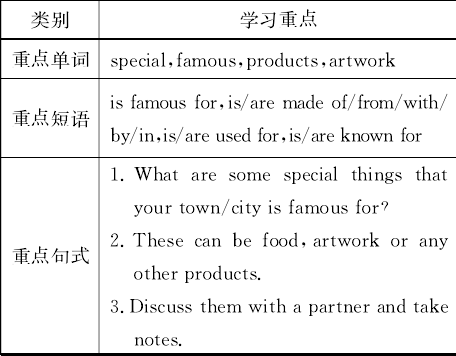
| 重点短语
| be made of/from,be made in,be known for, as far as I know, by hand, be good for, around China
| 重点句式
| - 1.What are the shirts made of?
- I 2. It was made in Thailand?
- 3. What is the painting made from?
- 4.Anxi and Hangzhou are widely known for their tea.
- 6.When the leaves are ready, they are picked by hand and then are sent for processing.
|
【课堂导学案】
Step 1情景导入(3分钟)
T :Do you know what are the things we use and see made of/ from? Most of them were made in China. And you can also see the things made in China in other
countries. Some things were first made/ produced in Chi-- na,such as tea, paper making, printing and so on. What else do you know were made in China?
环节说明:通过情景导入引导学生对中国的爱,又可以直接把学生引入新的知识点“be made of/from/in …’’
Step 2完成教材la〜2d教学任务
1要求学生翻开课本P33页,快速阅读1a表格部分的内容。把物品和可能构成他们的材料匹配起来。 (1分钟)
2.要求学生听第一遍录音,并完成课本上lb的听力任务。(1分钟)
3•要求学生听第二遍录音,并逐句进行跟读。(2分钟)
- 要求学生先练习1a中的对话,再模仿1c的对话,用lb表格中的信息进行对话练习。并邀请2 — 3对同学当堂进行演示。(3分钟)
- 小结训练。要求学生在规定的时间内完成一个 小练习。并请若干学生给出自己的答案。有错误的话 及时纠正。(2分钟)
用括号内所给动词的正确形式填空。
- The apples are sent (send) to the factory for processing.
(2)We are all ready but Tom hasn’t packed (pack) his clothes yet.
(3)The windows of the room are cleaned (clean)every day.
(4) The best cotton is produced (produce) in Xing Jiang in China.
(5)The song isn’t liked (not like) by most of us.
- 要求学生翻开课本P34,要求学生听第一遍录音,完成2a,2b的听力任务。(1分钟)
7•要求学生听第二遍录音,并逐句进行跟渎。(2分钟) 8.听力内容巩固训练。要求学生根据所听到的内容完成下列各句。完成后要求若干学生给出自己的答案。以巩固对听力内容的了解。(分钟)
A :What did you see at the art and science fair?
B:I saw a model plane.
A: What is it made of?
B:It’s made of steel.
A: Where was it made?
B:It is made in Beijing.
9.大声朗读听力材料。(1分钟)
10.放下听力材料,要求学生模仿听力内容,利用 2a,2b的信息分角色练习对话。然后邀请2 — 3对同 学当堂演示。看哪一对的表现最佳。(5分钟)
- 播放2d的对话录音,让学生跟读,模仿并理解大意。然后让学生分角色朗读并表演2d的对话。(5 分钟)
- 对话内容巩固训练。要求学生根据2d的对话 内容完成下列各句。完成后要求若干学生给出自己的 答案,以巩固对对话内容的了解。(4分钟)
- Chinese is famous for tea both in the past and now.
- As far as I know,tea plants are grown on the sides of mountains.
- When the leaves are ready, they are picked by hand and then are sent for processing.
(4)The tea is packed and sent to many different countries and places around China.
(5) People say that tea is good for both health and business!
( A ) ( 1) The bike Shanghai. It?s made
Steel.
( C ) ( 2) The West Lake is known the beautiful
scenery.
A.by B.as
C.for D.of
(D ) (3)The tea before it is sold.
A. packs B. is pack
C. packed D. is packed
(B ) ( 4) The coat is cotton.
A. made in B. made of
C. made from D. making of
Step 3问题探究(3分钟)
(B ) 1. Tea is in Hangzhou.
A. made B. grown
C. growing D. producing
( C ) 2. Paper is made trees and other
plants.
A of B in
C. from D. with
( C ) 3. Supper is ,we are ready
Supper.
A. ready;to B. ready for;for
C. ready;for D. ready for;to
【课后作业案】
完成本书课后提升案对应练习。
第 2 课时 SectionA(3a〜4c)
【学习目标】
类别
| 学习重点
| 重点单词
| cap, glove, local, France, avoid, germa- ny,product,handbag,mobile,everyday, boss,surface,traffic,material,postman
| 重点短语
| no matter what , i n fact , mobile phone, made in China,traffic accidents
| 重点句式
| - 1.No matter what you may buy,you might think those products were made in those countries.
- 2.He found it interesting that so many products in the local shops were made in China.
- T 3.Toys are not the only things made in
China.
- 4.He realized that Americans can hardly avoid buying products made in China.
|
【课堂导学案】
Step 1复习(1分钟)
用实物让学生问答产品制作原材料产地。
(1)—What’s itmade of/from?
—It’s...
(2)—Where is it made?
—It’s made in•…
Step 2情景导入(2分钟)
T:If you go to another country, what kinds of things would you buy? Maybe you v/ill buy a watch in Switzer- land,a camera in Japan and so on But you might see the watch/camera witha Made in China'. So you can see the things made in China no matter which country you go to.
环节说明:通过老师的介绍,学生对短文有所了解,也巩固了“(be)made in”的用法。
Step 3完成教材3a〜4c教学任务
- 要求学生快速默读短文,熟知大意,并找出康健 想在美国买哪两样东西以及它们都是哪儿制造的。然 后邀请几位同学给出自己的答案,全班一起检查讨论。 +(3分钟)
- 先邀请几位同学阅读短文(可一人一段),教师 要注意语音,及时纠正。然后播放录音,全班同学一起跟读。(3分钟)
- 短文内容巩固练习。教师可给出一篇改写了的 短文,将一些重点的表达方式空出。让学生在规定的 时间内补全短文。然后邀请若干同学给出自己的答案。(4分钟)
Now more and more Chinese travel foreign for vacation, they found it’ s interesting that wherever
they go, they could find the products that made in
China. China is widely known for making every-
day things,such as football,
| handbag
| ,mobile
| phones. These things are packed and sent to all
| parts of the world. Even in the
| local
| shops,the
| Americans realized that they
| can hardly
| avoid
| buying products made in China.
| However
| ,we wish
|
that in the future China will also get better at making high—technology products that people can buy in
all parts of the world.
- 完成教材3b的任务,要求学生再次阅读短文, 回答3b中所提出的问题。(5分钟)
- 再细读一遍3a的短文,写出3c中所给的词分别指代什么。(3分钟)
- 要求学生翻开课本P36,完成4a的任务,并请5 位同学朗读句子,全班集体核对答案。(5分钟)
7.参照4b所提供的信息和例句,用被动语态改写句子,并请4位同学在黑板上改写,全班集体核对答案。(5分钟)
8.先根据4c方框所提供的单词,依照4c方框所提供的对话,向五位同学询问他们穿戴的及书包中所包含的物品,然后再与同伴交流讨论。(5分钟)
9.小结训练。要求学生在规定的时间内完成一个小练习。并请若干学生给出自己的答案。有错误的话及时纠正。(2分钟)
Step 4问题探究(3分钟)
(B ) 1. The teacher is the boy in school.
A. searching B. searching for
C. searching at D. looking
D )2. — Where was it ?
一It was made in Japan.
A. made in B. made from
C. made of D. made
C )3. He gets up early . This is his
habits.
【课后作业案】
完成本书课后提升案对应练习。
第 3 课时 Section B(1a〜2e)
【学习目标】
类别
| 学习重点
| 重点单词
| international,its,form,ballon,scissors, lively, heat, complete
| 重点短语
| find out, go on a vacation, learn/know about, fly a kite,different kinds of,be famous for , such as , turn into , send out , ac- cording to,in trouble,be covered with,rise into,be seen as,symbols of,put on
| 重点句式
| - Laura is trying to find out more about what Zheng Yun thinks about Weifang.
- Zheng Yun tells laura about how to make a kite.
- The international kite festival is held in weifang every year.
- Some of the kites Zheng Yun saw were made of paper and bamboo.
|
【课堂导学案】
Step 1复习(1分钟)
让学生介绍自己家乡的特产。(例如茶)要有种植地,怎样生产?
Step 2情景导入(2分钟)
T: We all know about kites. Do you know what kites are made of? Who can tell me how to make a kite? Do you know about the international kite festival?
环节说明:教师的情景导入让学生对“be made of” 的用法加强了巩固,同时学生对风筝非常熟悉,在老师 的情景诱导下都非常乐意表达。
Step 3完成教材la〜2e教学任务
1.要求学生翻开课本P37,迅速阅读1a部分的内 容。并按要求完成课本上相应的任务。然后要求5— 8名同学给出自己的答案,教师可把这些句子在黑板 上列举出来以进一步巩固被动语态的结构。(3分钟)
- 听第一遍录音,完成课本上lb部分的任务。找 2个同学核对答案。要求读出序号和完整的句子。(2分钟)
- 听第二遍录音,完成课本上1c部分的任务。在播放录音前,要求学生抓住要点,并注意一些听写技 巧。核对答案时,要求先读出要填写的单词,然后读出 完整的句子。(3分钟)
4.听第三遍录音,用听到的内容完成课本上Id部分的句子。找5个同学朗读句子核对答案。要求读出 序号和完整的句子。(3分钟)
- 听第四遍录音,并打开听力材料,全班逐句进行 跟读。(2分钟)
- 放下听力材料,要求学生模仿听力内容,利用 lb,ld的信息分角色练习Laura与Zheng Yun的对 话。然后邀请2 — 3对同学当堂演示。看哪一对的表现最佳。(5分钟)
7.要求学生快速默读短文,熟知大意,并完成短文后的表格。然后邀请几位同学给出自己的答案,全班 一起检查讨论。(3分钟)
8.先邀请几位同学阅读短文(可一人一段),教师要注意语音,及时纠正。然后播放录音,全班同学一起跟读。(3分钟)
9.让学生再细读短文,回答2c所提出的问题,全班一起检查讨论。(5分钟)
- 用2d方框中所给短语的正确形式完成句子。 然后请一个同学朗读句子,核对答案。(5分钟)
11让学生分组讨论一下2e所提出的问题。(3分 钟)
第4课时Section
【学习目标】
12.小结训练。(3分钟)
(C ) (1) The international kite festival every
year.
C is held D. was held
( C )(2)Some kites paper and bamboo that
I saw.
C. were made of D. were made from
( D ) (3) I didn’t know that could be so
exciting.
A. fly a kite B. kite fly
C. kite to fly D. kite flying
环节说明:听的训练和写的训练结合,能促使学生 在听的过程中注意力更集中,同时对所学知识有及时巩固之效。
Step 4问题探究(2分钟)
(C ) 1 I don’t knowhow a kite.
A. make B. fly
C. to make D. made
( D )2. He is trying to who held the internationalkite festival.
A. find B. discover
C look for D. find out
【课后作业案】
完成本书课后提升案对应练习。
B(3a〜Self Check)
【课堂导学案】
 Step 1复习(2分钟)
复述做风筝及放风筝的过程。
Step 2情景导入(2分钟)
T: China is a country with traditioml art. Each part has its own specill forms of traditioml art. What do you know about folk or traditional art, like paper cutting?
环节说明:把学生调整到学习的最佳状态,当学生 听到老师的介绍,一定会迫不及待地想了解中国的各种传统艺术。
Step 3完成教材3a〜SelfCheck教学任务
1完成表格。(8分钟)
- 用表格中所给的expressions写一篇关于产品
的文章。
4.小结训练。(5分钟)
用方框中词的正确形式填空。
see, rise, happy, light, cover
(1) The stars are seen on bright night.
(2) He lit the candle and left his mother’s room.
(3) We can see the lanterns rise into the air slowly.
(4) Your eyes are covered with your hair. It’s bad for your eyes.
(5) Gifts bring children happiness .
根据句意及首字母提示完成句子。
- This bird is very clever and it can open the cover of the bottle with i tsown mouth.
- The old man can cut many different kinds of paper cutting with s cissors .
(3)The bag slowly rose into the air like a b alloon .
(4) Thanks to the sun,it gives us the light and the heat .
(5 )It took the man three months to c omplete his
new novel.
环节说明:阅读短文的同时完成练习,能促使学生在阅读过程中注意力更集中,也练习了所学知识点。
Step 4问题探究(3分钟)
(B ) 1. Taiwan is a treasure island (宝岛).
A. looking as B. seen as
C. watched D. regard as
(B )2. He wants to turn his books Eng
lish.
A. in B. into C as D. with
( C ) 3. The clay piece was and sent to
fire.
A. dry B. drying
C. dried D. dryed
【课后作业案】
完成本书课后提升案对应练习。
Unit 6 When was it invented?
第1 课时Section A(1a〜2d)
【学习目标】
类别
| 学习重点
| 重点单词
| style, project, pleasure, daily, website, pioneer,list,mention,have a point
| 重点短语
| be used for doing sth, my pleasure, in one’s daily life,be invented by
| 重点句式
| - When was the telephone invented?
—They are used for heating the cold
ice-cream.
- Think about how often it’s used in our daily lives.
- It mentioned that the zipper was invented by Whitcomb Judson in 1893.
|
【课堂导学案】
Step 1情景导入(5分钟)
T: There are many useful things in the world. They help us a lot in life. ( Show some pictures on the screen) Question: When were they invented?
Students :
- The telephone was invented in 1876.
- The computer was invented in...
环节说明:通过课前的一个师生问答互动引入新课的话题;通过图片的展示和语言的描述创设了情境, 激发了学生的学习兴趣和表达欲望。
Step 2完成教材la〜lc教学任务
- 要求学生迅速阅读1a部分的内容,并按要求完成课本上相应的任务:“ Number the pictures ”。 (1分钟)
- 检查答案,要求全班一起给出答案并检查讨论。 (3分钟)
- 要求学生听第一遍录音,并完成课本上lb的听力任务:“Listenand match the inventions with the years.”。检查他们的答案,读出序号——读出年份——读出完整的句子。(2分钟)
4.要求学生听第二遍录音,并逐句进行跟读。 (2分钟)
- 完成教材lc的任务,要求学生模仿la内容,进行对话练习,并邀请2〜3对学生当堂进行演示。 (3分钟)
用所给词的适当形式填空。
- When was the telephone invented (in
vent) ?
(2)It was invented (invent)in 1876.
环节说明:通过学习la,使学生对几种重要的发明有所了解,并拓宽了思路;通过学习lb,锻炼学生的听力及抓取关键信息的能力;通过lc的训练锻炼学生的口头表达能力,同时巩固对本课内容的认识。
Step 3完成教材2a〜2d教学任务
- 要求学生翻开课本。播放第一遍录音,完成2a、 2b的听力任务,然后个别检查,统一核对答案。 (2分钟)
- 要求学生听第二遍录音,并逐句进行跟读。 (2分钟)
- 听力内容巩固训练。要求学生根据所听到的内容完成下列各句。完成后要求若干学生给出自己的答案,以巩固对听力内容的理解。(4分钟)
The shoes with lights are used for seeing in the dark. They were invented by Julie Thompson. This hot ice-cream scoop is used for scooping really cold ice-cream . The shoes with special heels are used for changing the style of your shoes.
4.大声朗读听力材料。(1分钟)
5.放下听力材料,要求学生模仿听力内容,利用 2a、2b的信息分角色进行对话练习。然后邀请2〜3 对学生当堂演示,看哪一对的表现最佳。(5分钟)
6.角色扮演(读2d对话,然后表演)。(7分钟)
环节说明:将听、说、读、写的任务结合起来,不仅锻炼了学生的语言综合运用能力,还巩固了学生对被 动语态的学习、识记和运用。
7.小结训练。(5分钟)
按要求完成下列各题。
(1)Cars were invented in l885.(对画线部分提问)
Whenwere cars invented?
(2)Julie Thompson invented electric slippers.(改为被动 语态)
Electric slippers were invented by
Julie Thompson.
(3) The shoes with lights are used for seeing in thedark.(对画线部分提问)
What are the shoes with lights usedfor ?
(4)The light bulb was invented by Thomas Edison.(对画线部分提问)
Whowas the light bulb invented by?
(5)The refrigerator is used to keep food fresh (改为
同义句)
The refrigerator is used forkeeping food
fresh.
Step 4问题探究(3分钟)
( B ) l. Columbus America in l492.
A. invented B. discovered
C. found D. found out
( A )2. A pen is writing.
A. used for B. used to
C. used by D. used as
(B )3. Smith a new teaching method(方法).
A. discovered B. invented
C. is discovered D. was invented
【课后作业案】
完成本书课后提升案对应练习。
第 2 课时 SectionA(3a〜4c)
【学习目标】
类别
| 学习重点
| 重点单词
| nearly, ruler, boil, remain, lock, earthquake, biscuit, instrument, fridge, smell, national, doubt, somebody, sudden,
t ad trade,"translate,"bel l,"cookie",musical
| 重点短语
| by accident , t ake place , without doubt, over the open fire , at a low price , trans- late. . . into , a11 of a sudden
| 重点句式
| - 1.When was tea first drunk?
- T 2.The most popular drink in the world was invented by accident.
- I 3.It’s said that a Chinese ruler called Shen Nong was the first to discover tea as a drink.
- S 4.Some leaves from a tea plant fell into the water and remained there for some time.
- 5.The book describes how tea plants were grown and used to make tea.
|
【课堂导学案】
Step 1复习(1分钟)
谈论汽车。
—When was the car invented?
—It was invented in...
Step 2情景导入(3分钟)
T : Give three questions and lead in to new knowledge.
- Do you drink tea every day?
- Who invented tea in history?
- Do people in other countries drink tea in their daily life?
环节说明:通过带着问题去学习短文,从而达到导入新课的目的,同时也可以使学生积极阅读短文,以了解更多的关于茶的知识。
Step 3完成教材3a〜3c教学任务
1.要求学生快速默读短文,熟知大意,并完成课本 3a的任务,然后邀请几位学生给出自己的答案,全班 一起学习讨论。(3分钟)
要注意学生的语音,给予必要的朗读指导。然后播放录音,全班学生一起跟读。(3分钟)
- 读短文完成3b的任务(回答问题)及3c的任务 (填空)。(8分钟)
- 短文内容巩固练习。教师可给出一篇改写了的 短文,将一些重点的单词空出,让学生在规定的时间内补全短文,然后找若干学生给出自己的答案。 (4分钟)
Do you know tea? Tea is the most popular drink in the world. But to our surprise, it was invented by accident. It wasn’t brought to the Western countries earlier. An ancient Chinese ruler Shen Nong discovered tea when he was boiling drinking water in the open air. Some leaves from a tea plant fell into the water and remained there for some time. And it has a nice smell. He tasted the brown water and it was delicious. And in this way, tea was invented.
环节说明:将听、说、读、写的任务结合起来,不仅锻炼了学生的语言综合运用能力,还巩固了学生对语 言目标的学习、识记和运用;同时,学生们还可以从茶 的发现中获得生活的启示:要认真观察生活、实践生活,才能享受生活。
(B )(1)Heis 50 years old.
A.near B.nearly C.nearby
(C ) (2) The flowers produce a nice .
A. taste B. sound C. smell
( A ) (3) Some from a tea plant fell
—the water.
A. leaves;into B. leafs;into
C. leaves;off D. leafs;off
( B ) (4) They all wished us .
A. are remained B. to remain
C. remaining D. be remained
Step 4完成教材Grammar Focus〜4c教学任务
1.要求学生翻开课本P44,参照4a所提供的信息 和例句,用被动语态改写句子,并请4位同学在黑板上 改写,全班集体核对答案。(5分钟)
- 用所给单词的正确形式完成4b句子。并请5 位同学朗读句子,全班集体核对答案。(5分钟)
- 先浏览4c的短文,确定空格处的动词是用主动形式还是被动形式,然后用动词的正确形式填空完成短文。 并请1位同学朗读短文,全班集体核对答案。(5分钟)
练习。并请若干学生给出自己的答案。有错误的话及时
纠正。(2分钟)
用括号内所给单词的适当形式填空。
(1)This instrument is used for playing (play)
music in class.
(2 ) How many magazines were borrowed
(borrow) from the library today?
(3) Edison was a great inventor . He had over
1,000 inventions in his life, (invent)
(4) A picture was put (put) on the blackboard
before class.
(5 ) Plates and dishes weren’t washed ( not
wash) after supper yesterday.
Step 5问题探究(2分钟)
(B )1.The food delicious,I needn’t taste
It.
(C )2. I will stay in Wuhan for .
He was born in the 19thcentury .
A big change took place in our school last
year.
【课后作业案】
完成本书课后提升案对应练习。
第 3 课时 Section B(1a〜2e)
【学习目标】
类别
| 学习重点
| 重点单词
| Sou sour, customer,crispy,salty enough,
Info information
| 重点短语
| by by mistake, in the end,were invented in,
in "l lotsof
| 重点句式
| - D 1.Did you know potato chips were invented by mistake?
- T 2.The customer said they were not salty enough.
- B 3.Basketball is a much —love and active sport that is enjoyed by many for fun and exercise.
- I 4.It is believed that the first basketball game in history was played on December 21,1891.
- 5.At the same time, they need to stop the competing team from getting the ball into their own basket.
|
【课堂导学案】
Step1复习(2分钟)
简要复述茶是怎样被发现的。
Step 2情景导入(2分钟)
T:Some inventions have changed our lives, such as telephone, cars, computers and so on. They are helpful. But some inventions were invented by accident or by mistake. They are also helpful to us. Tea was invented by accident. And we will learn the inventions that were invented by mistake. Do you know what it was?
环节说明:教师用已学的知识导入新课,用学生未学的知识来激发学生的兴趣,同时巩固了语法点“be invented”。
Step 3完成教材la〜2e教学任务
1.要求学生翻开课本,迅速阅读1a部分的内容,并按要求完成课本上相应的任务:“Writewords to describe the tastes of the food in la. ”,然后要求 4 名 学生给出自己的答案,并进行个读、齐读。(2分钟)
2.要求学生完成lb部分的任务:“Write another kind of food of the same taste. ”,然后找几名学生给出自己的答案。并把收集的答案列举在黑板上。(4分钟)
【参考案例】
sweet bananas;crispy potato chips;salty noodles; sour grapes.
3.听第一遍录音,完成课本上lc部分的任务: “Listen and circle T or F. ”,然后分别地检查他们的答案。(2分钟)
4.听第二遍录音,完成课本上ld部分的任务: “Listen and complete the sentences. ”,检查答案,然后 大声朗读。(2分钟)
- 听力内容巩固训练。要求学生根据所听到的内容完成下列对话。完成后要求若干学生给出自己的答 案,以巩固对听力内容的理解。(3分钟)
Do you like potato chips? Do you know how the potato chips were invented? Now,let’s listen and fill in the blanks.
Potato chips were invented by mistake. They were invented by a cook called george Crum. One day a customer thought the fried potatoes werent thin enough and weren’t salty enough. So george cut them really thin and cooked them for a long time until they were crispy. And he put a lot of salt on them so they were salty.
- 听第三遍录音,并打开听力材料,全班逐句进行跟读。(2分钟)
7.放下听力材料,要求学生模仿听力内容,利用 lc、ld的信息分角色进行对话练习。然后邀请2〜3对 学生当堂演示,看哪一对的表现最佳。(5分钟)
8.要求学生快速默读短文,熟知大意,并找出各段 的主题大意。然后邀请几位同学给出自己的答案,全 班一起检查讨论。(3分钟)
9.先邀请几位同学阅读短文(可一人一段),教师要注意语音,及时纠正。然后播放录音,全班同学一起 跟读。(3分钟)
10.让学生再细读短文,完成2c所给的记忆图,并
适当添加其他信息。(3分钟)
- 借助2c的信息记忆图和你的同伴一起利用2d 所给的问题一起来总结篮球的发展过程。(3分钟)
- 让学生分组先讨论一下你认为一些著名的运动员怎么样,列举一些要成为一名著名的篮球队员有哪些困难,完成2e的任务。(3分钟)
环节说明:将听、说、读、写的任务结合起来,不仅 锻炼了学生的语言综合运用能力,还巩固了学生对目 标语言的学习、识记和运用;薯条被发明的小故事有很 强的趣味性,让学生体会到了学习英语的乐趣。
根据汉语提示完成句子。
⑴对不起,我刚才错拿了你的字典。
Sorry,I took your dictionary by mistake
just now.
(2)薯条被炸了很久。
The potato chips were cooked for a long
Time.
(3)它们不够咸。
They were not salty enough .
(4)你知道薯条的历史吗 ?
Do you know thehistoryof potato
chips?
根据句意及汉语提示完成句子。
(1)She is Canadian (加拿大人),but her Chinese
is excellent.
(2) We were divided (分开)into eight groups by
our teacher last week.
(3)The little boy dreams of becoming a profession-
al_ (职业的)football player.
(4)Yue Fei was a national hero (英雄)in old Chi
nese history.
(5) These apples were picked by hand and were packed withbaskets (篮子).
Step 4问题探究(2分钟)
The news makes me sad ..
I made the customer happy in the end .
【课后作业案】
完成本书课后提升案对应练习。
第 4 课时SectionB(3a〜Self Check)
【学习目标】
类别
| 学习重点
| 重点单词
| invention, business, description, imagine
| 重点短语
| take notes,is used for,It’s hard to..., come upwith....
| 重点句式
| - Think of something that you do not like to do.
- Write a description of your new invention
- This special pen was invented by Liujie. It has three colors and is used for...
|
【课堂导学案】
SteP1情景导入(3分钟)
Questions :
- Do you watch basketball games?
- How much do you know about this sport?
Step 2 完成教材3a〜SelfCheck教学任务
- 根据3a所给表格列举出的内容提示,想些你不喜欢做的事,然后想一些发明来帮助你,然后和同伴进 行交流,写出提要。(3分钟)
- 假设你现在是一名商人,根据3a写的提要以及 3b方框中所给的句型、短语提示写出一篇描述你的新发明的文章,介绍这种新产品并设法卖给你的同学们。 学生完成后评出优秀的作文在班上展示。(5分钟)
- 用方框中所给单词的正确形式完成1部分的短文,然后让1位学生朗读短文同时核对答案。(5分钟)
4用被动语态改写句子。让5位学生在黑板上 做,同时核对答案。(5分钟)
5.查找更多有关你最想了解的一项发明的信息, 然后用所给提示写句子。(4分钟)
Step 3问题探究(4分钟)
(C )1. It’s that the earth is round.
C. believed D. saying
( D )2. A number of the students on the
playground now. The number
3,000.
A. is;is B. is;are
C. are;are D. are;is
( B )3. The traffic accident stopped me from
_to the station on time.
A. get B. getting
C. to get D. got
( C )4. He dreamed a snake(蛇).
A. on B. with
C. of D. in
根据句意及汉语提示完成句子。
1. These people were divided (分开)into two
groups according to their ages.
2. Look, a few pear remain(保留)on the trees. Let’s pick them.
3. It’s said that the potato chips were invented by
mistake(错误).
4. The hot weather made the milk sour(酸的).
5. My gandparents often goes shopping with a basket (篮子).
【课后作业案】
完成本书课后提升案对应练习。
Unit 7 Teenagers should be allowed to choose their own clothes.
第1 课时SectionA(la 〜2d)
【学习目标】
类别
| 学习重点
| 重点单词
| license, safety, smoke
| 重点短语
| the driver’s license,the shopping center,no way, be worried about, be allowed to do, take photos of,get one’s pierced,be excited about, sixteen-year-olds
| 重点句式
| - Sixteen-year-olds should be allowed to drive.
- They arent serious enough.
- Do you think we may be allowed to take photos if we don’t use a flash?
|
【课堂导学案】
Step 1情景导入(5分钟)
每个青少年在生活中都会被允许或不被允许做某事,例如在商场购物时,我们应该被允许选择自己的衣 服,而父母却不允许我们选择自己的衣服,你们有这样的经历吗?你们是赞同还是不赞同呢?请大家说出自己的观点。
T :Could you tell me what students should be allowed to do or shouldn’t be allowed to do?
Ss:(1) Students should be allowed to have part - time
jobs.
(2)Students shouldn’t be allowed to get their ears pierced.
环节说明:通过课前师生互动,让学生在自己感兴趣的话题上产生共鸣,调动学生学习的积极性,同时“be allowed to do sth”的应用,为学习新课埋下了伏笔。
Step 2完成教材1a〜1c教学任务
1要求学生翻开课本P49,迅速阅读la部分的内容,然后自己判断赞同还是不赞同1a的内容。(1分)
【参考案例】
T:I don’t think students should be allowed to go to Net Bar.
Ss: I agree.
- 要求学生听第一遍录音,并完成课本上lb的听 力任务。(1分钟)
4.要求学生听第二遍录音,并逐句进行跟读。(2分钟)
- 完成教材1c的任务,要求学生根据1a中的陈 述,利用方框内的短语编写对话,进行练习,然后要求 2〜3位学生上台表演。(3分钟)
- 听力内容巩固训练。要求学生根据所听到的内 容完成下列问题,完成后要求若干学生给出自己的答 案,以巩固对听力内容的理解。(4分钟)
What is the relationship of the two speakers?
Mother and daughter.
The woman doesn’t think sixteen- year- olds should be allowed to drive because they aren’t serious enough. Anna thinks teenagers should be allowed to choose their own clothes because she is not a child.
环节说明:将听、说、读、写的任务结合起来,不仅 锻炼学生的语言综合运用能力,还巩固学生对目标语言的学习、识记和运用。
Step 3完成教材2a〜2d教学任务
1要求学生翻开课本P50。播放第一遍录音,完成2a、2b的听力任务。(1分钟)
- 要求学生听第二遍录音,并逐句进行跟读。 (2分钟)
3.完成教材2c的任务,要求学生模仿听力内容, 使用“should be allowed to”进行对话练习,并邀请2〜3对学生当堂进行演示。(3分钟)
4.读2d对话,然后表演。(5分钟)
5.小结训练。(4分钟)
根据汉语提示完成句子。
(1)青少年应该被允许选择他们自己的衣服。
Teenagers shouldbe allowedto
choose their own clothes.
Sixteen-year-oldsshouldnot be
allowed to drive.
(3)老师来的时候 ,你们应该停止说话。
You should stoptalking when the teach
er comes in.
(4)他想花费些时间与朋友在一起。
He wants to spend sometime with
his friends.
环节说明:通过学习2a〜2d,使学生对“should beallowed to”的结构有所了解;同时锻炼学生的听力及 抓取关键信息的能力;锻炼学生的口头表达能力,巩固 对含情态动词的被动语态的结构的认识。
Step 4问题探究(3分钟)
( C )1. I think is the first.
A. safe B. safely C. safety
( B )2. He wants to get his hair .
A. cuts B. cut
C. cutting D. to cut
(B ) 3. She shouldn’t to drive.
A. allow B. be allowed
C isn’t allowed D. allowing
【课后作业案】
完成本书课后提升案对应练习。
第 2 课时Section A(3a〜4c)
【学习目标】
类别
| 学习重点
| 重点单词
| tiny , cry,field,hug,community,chance, educate,manage,lift,awful,regret,society, badly,poem
| 重点短语
| talk back , keep. . . away from,lift up, have a dream,think back to, make one’s own decision
| 重点句式
| - 1.When I was two running through the field,she made sure I was safe and kept me from danger.
- I 2.I should not be told what to do!
- I 3.I regret talking back , not listening to Mom.
|
【课堂导学案】
Step 1复习(2分钟)
让一两个学生谈论自己的家规,同时使用“be (not) allowed to do sth”。
Step 2情景导入(2分钟)
T: Someone hates family rules, but our parents are those who love best. These rules are used to protect you. Let?s think back to their love when you were young. Who can describe their love. For example, when you were babies crying all night, your mothers sang to you and stayed at your sides.
环节说明:老师把学生的情感引入到教学上,使学 生对本单元的一段诗更易理解。
Step 3完成教材3a〜3c教学任务
- 要求学生快速默读诗歌,熟知大意,并完成课本 3a的任务,然后邀请几位同学给出自己的答案,全班 一起学习讨论。(3分钟)
- 先邀请几位同学阅读诗歌(可一人一段),教师 要注意学生的语音,给予必要的朗读指导。然后播放 录音,全班同学一起跟读。(3分钟)
- 诗歌内容巩固练习。教师可给出一篇改写了的短文,将一些重点的表达方式空出。让学生在规定的 时间内补全短文。然后邀请若干同学给出自己的答案。(4分钟)
Only mother’ s love is true love in the world. She gives everybody everything all her life. When you are still a tiny crying baby, mother takes good care oi you as
much as possible . When you are awake,she always
holds you in her warm arms. When you can run
through the field, she feels very worried about your — safety and keep you away from danger . When you fall and hurt yourself, she will give you a hug and lift you up. On cold winter days, she always tells you to put on more clothes. She usually stands in the wind —waiting for you back from school. When you rush toschool without breakfast, she is always worried about you at home. She often cares about your study.
When you make some progress in your study at school,you will see the brightest smile on her face.
Mother is always ready to give her childreneverything she has, never to receive anything. Whattrue love it is in the world! So I will say to my mother , “My dear mother,I love you forever!”
4.完成教材3b的任务,要求学生再次阅读诗歌, 回答3b中所提出的问题。(5分钟)
- 想一次你做的一件你父母不让你做的事,把你的故事和你的同伴分享。(3分钟)
环节说明:将听、说、读、写的任务结合起来不仅锻 炼了学生的语言综合运用能力,还巩固了学生对目标 语言的学习、识记和运用。
【参考案例】
I remember when I was seven years old,I and my partners wanted to go to the zoo, my parents didn’t promise. But I didn’t follow them.
I and my partners went there. We were happy there and forgot the time. At lunch,my parents looked for me everywhere. And a few families were hardly crazy. At last they found us in the zoo. But when they saw us, they were not angry, but happy. Later on I understood my parents.
( B )(1) Parents always keep their children
Danger.
A. from B. away from
C. off from D. away off
(D )(2)When I was young,I like .
A. talk B. talk back
C talking to D. talking back
环节说明:将说、读、写的任务结合起来,不仅锻炼学生的语言综合能力的运用,还巩固学生对目标语言 的学习、识记和运用;同时,学生从小诗中领略到爱的 真褅,它是一节英语课,也是一节情感教育课。
Step 4 完成教材Grammar Focus〜4c教学任务
1.要求学生翻开课本P52,参照4a所提供的信息 和例句,用被动语态改写句子,并请4位同学在黑板上 改写,全班集体核对答案。(5分钟)
- 用所给单词的正确形式完成4b短文。请5位同学朗读短文,全班集体核对答案。(5分钟)
- 你和你的朋友将创办一个英语倶乐部,请参照 4c的对话,列举一个什么可以做,什么不可以做的清单。(3分钟)
- 小结训练。要求学生在规定的时间内完成一个 小练习,并请若干学生给出自己的答案,有错误的话及 时纠正。(2分钟)
用括号内所给单词的适当形式填空。
- LinTao thinks he is old enough to make his own decision (decide).
(2) In China,it’s very important to get the college education (educate) for teenagers.
- As a teenager, we should get more chance to do some social (society) work.
- At the meeting,Amy disagreed (agree) with Mr. Liu about this wrong activity.
(5) In China,smoking isn’ t allowed (allow)
when in public.
环节说明:将听、说、读、写的任务结合起来不仅锻 炼了学生的语言综合运用能力,还巩固了学生对目标 语言的学习、识记和运用。
Step 5问题探究(4分钟)
( C ) 1. Make meet my headmaster today.
A. sure B. sure of
C sure to D. sure that
(C ) 2. My hand yesterday, so my hand —
now.
A. hurt;hurts B. hurted;hurts
C. was hurt;hurts D. hurt;is hurt
(D )3. When I was seven years old,I regret
to my parents.
C not to listen
D not listening
(A )4 . When I was ten a bike to school,
my parents always worried about whether I would fall down.
A. riding B. to ride
【课后作业案】
完成本书课后提升案对应练习。
第 3 课时 Section B(la〜2e)
【学习目标】
类别
| 学习重点
| 重点单词
| support, enter, choice
| 重点短语
| get to class late, take a test later, pass the test,be strict with sb.,worry about failing the test,get in the way of ,be serious about,have nothing against doing sth,care about,make a choice oneself,achieve one’s dream, have a chance to do
| 重点句式
| l He should be allowed to take the test
later.
- I think parents should not be too strict with teenagers.
- Are you allowed to make your own decisions at home?
- We have nothing against running!
- I think I should be allowed to decide for myself.
|
【课堂导学案】
Step l情景导入(3分钟)
回顾:在前面的课程中我们已经学习并了解了一 些学校的规矩。下面通过回答几个问题来进行一下简 单的回顾。邀请几位学生尝试回答以下问题。
Questions :
- Do you always choose your own clothes?
- Do you usually go to the movies on weekends?
- Do you never go home late?
环节说明:课前的师生问答互动不仅让学生回顾 了上节课内容,进一步明确了学校的一些日常规则;而 且还可以很自然地导入到本节课的内容。
Step2完成教材la〜2e教学任务
- 要求学生翻开课本P53,迅速阅读la部分的内容。并按要求完成课本上相应的任务。然后要求 5〜lO名学生给出自己的答案。教师可把这些问题在 黑板上列举出来并进行一下排序,看哪个问题是最多学生碰到的。(3分钟)
【参考案例】
get to class late
| l
| study with friends
| l
| finish a test early
| 3
| worry about that you’ll fail a test
| 5
|
- 针对la中的问题,每个学生都有自己的回答, 请根据学生自己的答案来完成lb的任务。然后选出几名学生在全班汇报表演。(3分钟)
环节说明:针对学生的不同回答,教师做出总结: 根据学生们的回答,我能看出有些学生能遵守学校规 矩,有些则不能。也许你们认为这些规则是不合理的, 需要修改。下面我们听磁带,看这个男孩是怎么认为的。
环节说明:此环节以写作的形式出现,主要是通过学生的讨论进一步理解每个人都要遵守学校校规,同 时通过这个内容,也能看出学生到底喜欢什么样的老 师,使学生学会如何表达自己的思想,培养学生的思考能力。
8.小结训练。(3分钟)
用所给词的适当形式填空。
(1)They failed to get (get) to the top of the
mountain at last.
(2) You needn’t worry (worried)about your son.
(3) After you finish doing (do) your homework,
we’ll go to the park.
(4) Parents should not be too strict with teenagers (teenager).
(5) He should be allowed (allow) to take the test
later.
Step 3问题探究(2分钟)
( B )l. Our teacher is strict us
everything.
A. in;in B. with;in
C. with;with D. in; with
D )2. Nobody worries about the test.
A. passing B. to take
C to fail D. failing
【课后作业案】
完成本书课后提升案对应练习。
第 4 课时Section B(3a〜Self Check)
【学习目标】
类别
| 学习重点
| 重点短语
| play computer games, watch TV, agree with,be allowed to,would like to
| 重点句式
| - Why you agree or disagree with it.
- How you think the rule should be changed?
|
【课堂导学案】
step l复习(l分钟)
对话:
T: What shouldn’t be allowed to do in our school? SA: We shouldn’t be allowed to be late.
SB: We shouldn’t be allowed to get our ears pierced. SC:...
Step 2完成教材3a〜3b教学任务
1.根据3a所给表格列举出的内容提示,和你的同伴讨论你同意或不同意的家规,并写出提要填在表格中。(3分钟)
- 根据3a写的提要以及3b方框中所给的句型提示写出一篇日记来阐述你不同意你家的哪个家规以及 应如何改变。学生完成后评出优秀的作文在班上展示。(5分钟)
环节说明:本节主要是将读、写的任务结合起来不仅锻炼了学生的写作及对语言的综合运用能力,还巩 固了学生对目标语言的学习及综合运用。
( B ) (1) He has nothing against my homework.
A. finish B. finishing
C. to finish D. finished
( A ) (2) He has no chances to his dream.
A. achieve B. achieving
C come true D. coming true
(B ) (3)1 want to decide .
A. to myself B. for myself
C. myself decision D. a decision
( C ) (4) I think the poor health will getof your study.
A. on the way B. by the way
C. in the way D. a t the way
(B )(5)My father is a good doctor and I am
about wanting to be a doctor like him.
A. angry B. serious
C. surprised D. worried
Unit 8 It must
Step 3完成教材Self Check教学任务
1先把方框中的两栏单词连接起来构成短语,并 选其中
的5个造句。(2分钟)
- 用括号中所给单词的正确形式完成句子,并把它们译成汉语。请4位同学朗读自己的句子,核对答 案。(5分钟)
环节说明:本节主要是针对本单元的主要目标语言进行加强巩固训练,巩固了学生对目标语言的学习、 识记和运用。
Step 4问题探究(5分钟)
根据汉语提示完成句子。
1他自己作选择。
He made a decisionhimself .
He can achievehisdream .
I have succeeded in learning English.
4. 父母关心我们。
Parents careabout us.
5. 我有机会去,你没有理由反对。
I have chances to go there, you have
nothing against doing that.
【课后作业案】
完成本书课后提升案对应练习。
belong to Carla.
第 1 课时Section A(1a〜2d)
【学习目标】
类别
| 学习重点
| 重点单词
| Whose,"truck,"rabbit",valuable" , ,pink"
anybody, attend, picnic
| 重点短语
| listen to, belong to, at the picnic,pick up,go to a picnic
|
重点句式
| —It must be Mary’s.
- The hair band might belong to Linda.
| | =The hair band might be Linda’s.
| | 3. So it can’t be stolen.
| | 4. I think somebody must have picked it up.
|
【课堂导学案】
Step 1情景导入(3分钟)
The teacher prepared a large paper bag. Then ask four students in the class to put their heads down on their desks and not look at what you are doing. Meanwhile, collect one item each from the four students and place these items in a large paper bag. Ask all students to watch as you take out one item and place it where all the students can see it.
环节说明:通过课前的一个师生问答互动游戏,调 动了学生的课堂气氛,同时随着游戏的深入,使学生对 表示推测的情态动词用法有了基本认识。
Step 2完成教材1a〜lc教学任务
1要求学生翻开课本P57,迅速浏览所给的图片, 然后把图片中所给的物品填入到所给的栏目中。 (1分钟)
2.检查答案,先要求全班一起给出答案并检查讨 论。然后要求2〜3名学生就图片中所给的物品,使用 “Whose volleyball is this?”句型,给出自己的答案,并把收集的答案列举在黑板上。(3分钟)
【参考案例】
T: Whose volleyball is this?
Ss:It must/can’t be Carla’s.
- She doesn’t play volleyball at all.
3.要求学生听第一遍录音,并完成课本上lb的听 力任务。(1分钟)
4•要求学生听第二遍录音,并逐句进行跟读。(2分钟)
- 完成教材lc的任务,要求学生根据上面所给的 图片,使用lb表格中的信息编写对话进行练习,然后 要求2〜3对学生上台表演。(3分钟)
根据汉语提示完成句子。
It must be WangBing’s. It has his name
on it .
(2)这个卡车玩具属于鲍勃。
The toy truck belongs to Bob.
(3)这是谁的自行车?
Whosebike is this?
环节说明:通过学习la,使学生能够正确地判断物 品所属;通过lb,锻炼学生的听力及抓取关键信息的能力;通过lc的训练锻炼学生的口头表达能力,同时巩固了对情态动词must表推测的认识。
Step 3完成教材2a〜2d教学任务
- 要求学生翻开课本P58,迅速完成2a任务,播 放录音一遍,完成2b的听力任务。(1分钟)
- 要求学生听第二遍录音,并逐句进行跟读。 (2分钟)
4. 放下听力材料,要求学生模仿听力内容,利用 2a,2b的信息分角色练习对话完成2c。然后邀请2〜3 对学生当堂演示,看哪一对的表现最佳。(5分钟)
- 完成2d的任务。学生两人一组读对话,然后请 2〜3对学生到讲台前表演对话。(5分钟)
环节说明:将听、说、读、写的任务结合起来,不仅锻炼学生的语言综合运用能力,还可巩固学生对目标 语言的学习、识记和运用。
用must,might,could,can’t 填空。
(1) The toy must beBob’s. He is theonlykidHere.
(2) The beautiful trousers can’t be Tim’s. Theyare too long.
(3) The earrings might/may/could be Jane’s. Shesometimes wears earrings.
根据句意及汉语提示完成句子。
(1) We are planning to have a picnic(野餐)onislandnext week.
(2)To our surprise, the dog ran back with a rabbit (野兔)in his mouth.
(3)Tom’s fa (3)Tom’s father decided to drive his truck(卡车) to travel around the world.
(4)The thie (4)The thief didn't find anything valuable(贵重的) in the bag and threw it away.
(5)Jane's (5) Jane’s mother bought her a pink(粉红色的)
sweater as her birthday gift.
Step 4问题探究(4分钟)
(B )1 It can’t .
A. steal B. be stolen
C. stole D. be stole
( C )2. Somebody must the CD .
A. seen B. saw
C. have seen D. sees
A. Grace B. Grace's
C Grace’s mother’s D. mine
(C ) 4. The bag is .
A. my B. my sister
C mine D me
【课后作业案】
完成本书课后提升案对应练习。
第 2 课时 SectionA(3a〜4c)
【学习目标】
类别
| 学习重点
| 重点单词
| Noinoise, policeman, wolf, laboratory, coat,
Slee sleepy
| 重点短语
| have fun doing sth,run away,have no idea,at first
| 重点句式
| ! I t 1.I think it must be teenagers having
fun.
- A 2.At first, I thought that it might be a dog,but I couldn’t see a dog or anything else, either.
- T 3.There must be something visiting the homes in our neighborhood.
- T 4.The noise-maker is having too much fun creating fear in the neighborhood.
|
【课堂导学案】
Step 1复习(2分钟)
教师拿些学生的东西,让其他学生猜测所属(用推测性情态动词及belong to短语)。
Step 2情景导入(3分钟)
T :Not all of us can meet the strange events in our daily life. And we may think some of them are unbelievable. Let?s read the newspaper article quickly and see what happened to the people in the writer’s town. Try to find the answers to the questions.
(!) What happened in the writer’s town?
Every night they hear strange noises outside their windows.
It might be teenagers having fun and it also might be the wind or a dog.
Everyone is feeling uneasy and everyone has his or her own ideas.
环节说明:通过快速阅读短文,回答所给的问题, 能帮助学生更加全面地理解文章,训练学生的阅读能力及分析问题的能力。
Step 3完成教材3a〜3c教学任务
1.!再次要求学生快速默读短文,熟知大意,并完成课本3a的任务。然后请几位学生给出自己的答案,全班一起检查讨论。(3分钟)
- 先请几位学生阅读短文,教师要注意语音,及时纠正。然后播放录音,全班学生一起跟读。(3分钟)
- 短文内容巩固练习。教师可给出一篇改写了的短文,将一些重点的词语空出,让学生在规定的时间内补全 短文,然后邀请若干学生给出自己的答案。(4分钟)
Our town used to be very quiet. Strange things are happening in the neighborhood these days. When the local newspaper interviews Victor,a school teacher, he says he heard strange noises outside their window every night. His wife thinks it could be an ani-- mal. His friends and he think it must be teenagers having fun. His parents called the police, but they can’t find anything strange. The police think it might be the wind.
Helen is Victor’s next-door neighbor. She thinks it might be a dog,but she can’t see a dog.
Everyone is uneasy here. Everyone has his or her own ideas. There must be something visiting the homes in their neighborhood.
4.完成3b的任务。(3分钟)
- 再读文章,完成3c的任务,这部分主要是写的 练习,要求学生根据本书所学的内容用所给的人物写 出含有推测词的句子,教师及时检查学案。(5分钟)
环节说明:通过这部分的练习,可以提高学生的翻译能力及写作能力,同时也提高了学生自学的能力。
( C ) (1) Oh,my god! The birds are making too
much here. I can’t do anything.
A. sound B. voice
C noise D. footstep
( B )(2)I saw some teenagers creating
fear.
A. have fun B. having fun
C have D. having
( C ) (3 ) There must be an elephant
bananas in the zoo.
A. eat B. to eat
C. eating D. eats
( B ) (4) That policeman shouted loudly,“Don’t let
the thief from the shop!”
A. run B. run away
C buy D. save
Step 4 完成教材Grammar Focus〜4c教学任务
1.要求学生翻开课本P60,选择4a所给句子中括 号所给单词的最佳形式完成对话。然后请5组同学朗 读对话,全班集体核对答案。(5分钟)
- 根据提示,完成4b所给对话的答语。并请4位同学朗读所写的对话,全班集体核对答案。(5分钟)
- 引导学生观察4c的图片,让学生们猜测这是男孩的还是女孩的房间?并用4c方框中所给的对话进行讨论。(3分钟)
- 小结训练。要求学生在规定的时间内完成一个小练习。并请若干学生给出自己的答案。有错误的话及时纠正。(2分钟)
用must,might,could,can’t 完成对话。
A:Tom,you look worried. What’s the matter?
B:I can’t find the key to my bike. I might have lost it. A:Don’t worry. Let’s see where it could be.
B:I think I might drop it during the P. E. lesson. So it might still be on the playground.
A: What’s. your key like?
B:It’s yellow.
A:Look! Is it yours?
B:No,it can’t. bemine. It’s small but mine is a big
one.
A:I’m afraid you have to go to the Lost and Found to have a look.
环节说明:将听、说、读、写的任务结合起来不仅锻炼了学生的语言综合运用能力,还巩固了学生对目标语言的学习、识记和运用。
Step 5问题探究(4分钟)
( A ) 1. happened in our neighborhood.
(C )2. They have fun football.
A play
C playing
( D )3. There might be an animal .
(B )4 . I‘ve no that they are having fun, .
A . ideas;too
5.根据句意及汉语提示完成句子。
- 1 can’t fall asleep at all because there is too much noise (噪声)outside.
- The old man found a wolf (狼)lying in the snow.
- Alice is proud that both his father and brother are policemen (警察).
(4) Lily asked his neighbor (邻居)to help her
look after her pet dog while she was away.
(5) The bad boy often has fun creating fear (恐
惧)in the neighborhood.
【课后作业案】
完成本书课后提升案对应练习。
第 3 课时 Section B(1a〜2e)
【学习目标】
类别
| 学习重点
| 重点单词
| suit, alien, might
| 重点短语
| catch a bus, in the sky, wear a suit, the woman with a camera, not only ...but also… , point out, a medical purpose, a long period of time,at the same time,in a certain way, communicate with sb.
| 重点句式
| - Why do you think the man is running?
- He could be running for exercise.
- He is wearing a suit. He might be running to catch a bus to work.
- One of the greatest mysteries is how it was built.
- But we do know they must have been hardworking—and great planners!
|
【课堂导学案】
Step 1复习(3分钟)
让学生介绍自己经历过的奇怪的事。
Step 2情景导入(5分钟)
上课前,教师可以要求学生准备一些他们亲戚或者同班同学的一些照片,然后上课时,要求学生去猜他 们是谁。教师可以邀请两名学生在讲台上利用下面的对话进行猜测。
A:Who is he/she?
He/She could/might be ,because .
He/She must be ,because .
环节说明:这一环节的设置主要是继续巩固前面所学的情态动词表推测的用法,同时为下面继续学习这一用法奠定基础。
Step 3完成教材la〜2e教学任务
1.要求学生翻开课本P61,迅速浏览la中的图片,并按要求完成课本上相应的任务。然后要求5〜8 名学生给出自己的答案,教师可把这些问题在黑板上 列举出来,看哪个学生对图片把握得更好。(3分钟)
【参考案例】
The UFO is landing
| 2
| The alien is running after the man
| 3
| The man is running
| 1
|
2.听第一遍录音,完成课本上1a部分的任务。 (2分钟)
3.听第二遍录音,完成课本上1c部分的任务。 (2分钟)
锻炼学生的语言综合运用能力,同时还巩固了学生对 目标语言的学习、识记和运用。
l3.小结训练。(5分钟)
用所给词的适当形式填空。
- We see a man running (run)on the playground.
- Can you see anything (something) over there?
(3) He might be running to catch (catch)a bus.
(4) 1 think it can’t (can)be a helicopter.
(5)—Is he wearing (wear)a suit?
—Yes,he is.
Step 4问题探究(4分钟)
( C )l. He sees a man . Can you see it?
A. run B. to run
C. running D. ran
(D )2. It might be a baby .
A. cry B. to cry
C. cried D. crying
(B)3.The woman with a camera mightareporter.
A. is B. be
C. have D. has
(B )4. —Why is the old man running?
—He might be running exercise.
A. to B. for
C. with D. after
【课后作业案】
完成本书课后提升案对应练习。
第 4 课时Section B(3a〜Self Check)
Step 2情景导入(1分钟)
T :Have you seen any strange building full of mysteries? Tell us how mystic it is. But I have seen a mystic building called Stonehenge. Do you want to know about it? If you want,read the passage on P62.
环节说明:情景导入的一段文字调动学生的学习积极性,学生带着目的去读文章,效果一定很佳。
Step 3完成教材3a〜3b教学任务1.完成3a表格。(3分钟)
- 根据要求写一篇短文。(教师提示及指导)教师及时作检查,给出范文。(可以参考学生用书作文指导部分)(10分钟)
( B ) (1) The stones might communica
ting with gods for the ancient leader.
A. be B. have been used for
C. be used for D. was used for
(D )(2)What can prevent ?
A. ill B. illness
C. being illness D. illnesses
( A ) (3)It’s used for buildings.
A. building B. built
C. to build D. build
Step 4完成教材SelfCheck的教学任务
1.选用must,might,can’t填空完成句子,并请5 位同学朗读自己的句子,核对答案。(5分钟)
2.根据表格中的信息及例句提示写出关于表格下面各样品的句子。(3分钟)
环节说明:本节主要是针对本单元的主要目标语言进行加强巩固训练,巩固了学生对目标语言的学习、 识记和运用。
Step 5问题探究(4分钟)
( B ) 1.. He always wants to his true meaning.
A. expression B. express
C. say D. know
( C )2. The stone can prevent us from .
A. be ill B. be illness
C. being ill D. sickness
( C ) 3. I can’t point your mistakes be
cause I didnt find your mistakes.
A. at B. to
C. out D. with
( B )4. He must his best last year.
A. try B. have tried
C. tried D. tries
【课后作业案】
完成本书课后提升案对应练习。
Unit 9 I like music that I can dance to.
【学习目标】第1课时Section A(1a〜2d)
类别
| 学习重点
| 重点单词
| prefer,Australian, electronic, suppose,
smooth,"spare,"director,"war,"case
| 重点短语
| dance to,sing along with, different kinds of,in that case,World WarⅡ, think about
|
| 1.What kind of music do you like?
2. I like music that I can sing along with/dance to.
| 重点句式
| - Carman likes musicians who play different kinds of music.
- In that case,I’ll ask someone who likes serious movies.
|
【课堂导学案】
Step 1情景导入(1分钟)
T:Do you love music? Yeah, music is also my favorite. It makes my life more colorful. You know, there are different kinds of music in the world. (Playsomebeautiful music and gtt Ss to talk about it freely. )
环节说明:通过课前的一个师生问答互动引入新课的话题,美妙的音乐也把学生们带入了一个美好的 意境,学习兴趣不言自明。
Step 2完成教材1a〜lc教学任务
1要求学生翻开课本P65,迅速阅读la部分的内 容,并按要求完成课本上相应的任务。(1分钟)
2.核对答案,先要求全班一起给出答案并检查讨论。然后要求2〜3名学生就“I like music that ”给出自己的答案,并把收集的答案列举在黑板上。(3分钟)
【参考案例】
Tr:What kind of music do you like?
Ss:I like music .
- that I can sing along with
3.要求学生阅读表格中的信息,听第一遍录音,并完成课本上lb的听力任务。(1分钟)
4.要求学生听第二遍录音,并逐句进行跟读。教师给予必要的提示和朗读要领的指导。(2分钟)
- 完成教材lc的任务,要求学生模仿听力内容, 使用“一What kind of music do you like?
一I like music that…”进行对话练习,并请2〜3对学生当堂进行演示。(3分钟)
根据汉语提示完成句子。
What kind of music do you like ?
(2) 我喜欢有着美妙歌词的音乐。
I like music that has great lyrics .
(3)我的朋友更喜欢能够随之跳舞的音乐。
My friend prefers music that she can dance to .
(4)这位美国老太太喜欢能够随着哼唱的音乐。
The American old lady loves music that she
can sing along with.
根据句意及首字母提示完成句子。
(1 ) Beethoven was one of the most famous musici-
ans in the world.
(2) The lyrics of the song are very beautiful and
sound like poems.
(3) Which do you prefer ,classical music or pop music?
⑷Feng Xiaogang is a famous Chinese director ,
I like to watch his movies.
(5) I suppose that Alice may like the electronic
music.
环节说明:本环节初步学习了关于音乐的短语和描述音乐的定语从句。1a中的信息使学生们对定语 从句有了感性认识;lb训练了学生抓住关键信息的能 力;1c训练了学生们的英语口语表达能力。循序渐进、 水到渠成。
Step 3完成教材2a〜2d教学任务
1要求学生翻开课本P66,并要求学生迅速捕捉图片和文字信息,然后为他们播放第一遍录音,完成 2a、2b的听力任务。(2分钟)
- 要求学生听第二遍录音,并逐句进行跟读。教 师应作必要的听力和朗读指导。(2分钟)
- 听力内容巩固训练。要求学生根据所听到的内容完成下列各句,完成后要求若干学生给出自己的答案,以巩固对听力内容的理解。(4分钟)
Xu Fei:I prefer groups that play quiet and slow songs. I like musicians who write their own songs.
Carmen : I like electronic music that’s really loud. I like musicians who play different kinds of music.
4两人一组大声朗读听力材料。(1分钟)
- 放下听力材料,要求学生模仿听力内容,利用 2a、2b的信息分角色练习对话。然后请2〜3对学生当堂演示,看哪一对的表现最佳。(5分钟)
环节说明:将听、说、读、写的任务结合起来,不仅锻炼了学生的语言综合运用能力,还巩固了学生对目标语言的学习、识记和运用;同时,小组合作对话训练 了学生们的合作意识和团队精神;对话的当堂演示使 学生们有了学英语的成就感,张扬了个性。
7.小结训练。(4分钟)
( A )(1)I like music that I can sing along
—or dance .
A. with;to B. with; with
C. to;to D. to;with
( A ) (2)Most students like the teachers
can understand them well.
A. who B. when
C what D. which
(A )(3)—What are you looking for?
一I’m looking for the ring my
husband bought me last year.
A. that B. who
C. whom D. it
(A )(4)The basketball I bought yester
day cost me 80 yuan.
A.that B.whom
C.who D.when
Step 4问题探究(5分钟)
( A )1. Few children prefer to playing.
A. working B. to work
C work D worked
( A )2. I still remember that girl we saw
Yesterday.
A. who B. whose C which D. why
( C )3. He likes music he can .
A. dance B. sing along
C. dance to D. sing along on
( A )4. He loves singers write their own
music.
A.who B.that C.which
(D )5. I prefer movies that give me something
—about.
A. thinks B. thought
C thinking D. to think
【课后作业案】
完成本书课后提升案对应练习。
第2课时 Section A(3a`4c)
【学习目标】
【课堂导学案】
Step 1复习(1分钟)
问3一4个学生“What kind of music do you like?",让学生使用定语从句回答。
Step 2情景导入(3分钟)
T:Some people like a certain kind of movies.Some people like all kinds of movies depending onhow they feel that day. Please answer the questions.
(1)What do movies make you feel
(2) What kind of movie do you watch when youare sad?
(3) What kind of movie don't you like
尽量让学生用定语从句来回答。
环节说明:白_接导人新课,同时巩固了所学的语法知识
Step 3完成教材3a〜3c教学任务
1.要求学生快速默读短文,熟知大意,在短文中标出不同类型的电影及电影名字;然后邀请几位同学给出自己的答案,全班一起学习讨论。(3分钟)
- 先邀请几位同学阅读短文(可一人一段),教师 要注意学生的语音,给予必要的朗读指导。然后播放 录音,全班同学一起跟读。(3分钟)
- 短文内容巩固练习。教师可给出一篇改写了的 短文,将一些重点的表达方式空出。让学生在规定的 时间内补全短文。然后邀请若干同学给出自己的答案。(4分钟)
I like to watch different kinds of movies depending
on how I feel that day. When I am down or tired, I
prefer comedies and cartoons, because they can
cheer me up. I don’t watch dramas or documentaries, because they made me feel even sadder and I
don’t want to think too much. I don’t mind action
movies when I’m too tired to think. I can shut off my
brain ,sit back and enjoy watching an exciting
superhero who always saves the world just in
time.
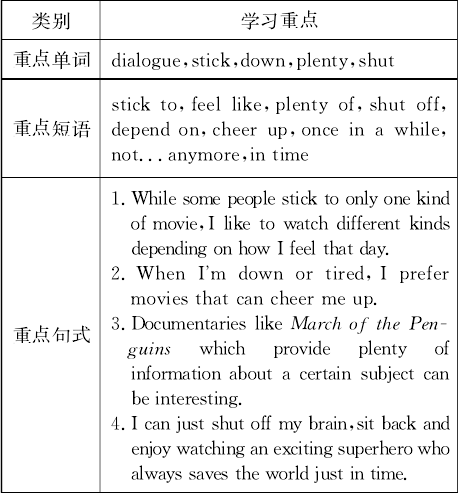 4.完成教材3b的任务,要求学生再次阅读短文, 回答3b所提出的问题。(5分钟)
环节说明:将听、说、读、写的任务结合起来不仅锻 炼了学生的语言综合运用能力,还巩固了学生对目标语言的学习、识记和运用。
( C ) (1) He feels like scary movies.
A. watch B. to watch
C. watching D. watched
(B )(2)He won’t depend anybody when
he is 18 years old.
A. in B. on C. with D. off
( C )(3)If you are really tired,you can shut
your brain and admire the flowers.
A. on B. of C. off D. up
(A )(4) I’m not so scary .
A. anymore B. no more
环节说明:通过阅读短文,回答所给的问题,能帮助 学生全面地理解文章,训练学生的阅读能力及分析问题 的能力,最后结合练习对所学知识进行及时巩固。
Step 4 完成教材Grammar Focus〜4c教学任务
1.要求学生翻开课本P68,选择4a所给表格中不同栏目的单词造句。然后请5组同学朗读对话,全班集体核对答案。(5分钟)
- 先阅读4b中关于Jennifer的CD简介,然后用 that,which,who引导的定语从句完成句子。全班集体核对答案。(5分钟)
- 依照4c方框中的对话,编造出一组对话,谈论你喜欢或不喜欢的事情。(2分钟)
4.小结训练。要求学生在规定的时间内完成一个小练习。并请若干学生给出自己的答案。有错误的话及时纠正。(2分钟)
句型转换,每空一词。
- Frank likes music that’s loud and energetic.(对
画线部分提问)
Whatkind of music does Frank like?
- I know the girl. She is reading under the tree.(合
并为一句)
I know the girl whois reading under
the tree.
- The boywho has short curly hair is Tom.(改为同义句).
The boy with short curly hair is Tom.
- The dictionary is helpful. He bought it last week.(改为定语从句)
The dictionary that he bought last week is
helpful.
- I hate people. They talkmuch but do little.(改为定语从句)
I hate people who/ thattalk much but do little.
环节说明:将听、说、读、写的任务结合起来不仅锻炼了学生的语言综合运用能力,还巩固了学生对目标语言的学习、识记和运用。
Step 5
| 问题探究(4分钟)
| | (
| D
| )l. He like flying to the moon.
| | | A. would
| B. woulds
| | | C. feel
| D. feels
| (
| B
| )2. If you stick to
| the gift now,you can
| | | open it.
| | | | A. open
| B. opening
| | | C. opened
| D. opens
| (
| D
| )3. ,he doesn’t
| play games,hewat-
| | | ches TV.
| | | | A. Sometime
| B. Some times
| | | C. On time
| D. Once in a while
| (
| C
| )4. He told me one of the best ways
| | | he often uses.
| | | | A.who
| B. whose
| | | C.that
| D. which
| 5.用所给单词的适当形式填空。
| (l) Mike doesn’t like food that has (have)
| chocolate in it.
| (2)The boy who is playing (play) with a dog
| is my younger brother.
| (3)1 can’t see the words on the blackboard
| clearly (clear).
| (4) Most of us like musicians (music) who
| play different kinds of music.
| (5)The boy who kicked (kick) the goals just
| now is Li Yang.
| 【课后作业案】
| 完成本书课后提升案对应练习。
|
第 3 课时 SectionB(la〜2e)
【学习目标】
类别
| 学习重点
| 重点单词
| sense, pain, reflect, perform, pity, master, praise,wound,sadness,total,painful
| 重点短语
| look up,in total,be known for,such as, get married,make money,in the way, by age...,during one’s lifetime
| 重点句式
| - H 1.He likes clothes that are unusual.
- I 2.I like movies that are scary.
- H 3.He likes writers who explain things well.
- B 4.But it was one of the most moving pieces of music that I’Ve ever heard.
- T 5.The music was written by Abing, a folk musician who was born in the city of WuXi in l893.
|
【课堂导学案】
Step l复习(3分钟)
让两个学生回答他们喜欢什么样的电影,并说明原因。
J
Step 2情景导入(3分钟)
回顾:在前面的课程中我们已经学习并了解了一些音乐的信息和同学们喜爱的音乐种类。下面通过回答几个问题来进行一下简单的回顾。请几位学生尝试回答以下问题。
Questions :
- Do you have your favorite band? What is it?
- How many members are there in the band?
- Which song of theirs do you like best?
当然,也可讨论他们最喜爱的书籍和影片。
环节说明:课前的师生问答互动不仅让学生回顾了上节课的内容,而且还可以很自然地导入到本节课 的内容,也为下一步的学习作了准备。
Step 3完成教材la〜2e教学任务
- 要求学生翻开课本P69,迅速阅读la部分的内容,并如实填写表格。然后要求5〜8名学生给出自己的答案,教师可选择一些列在黑板上。(3分钟)
- 完成lb左栏的任务。让学生看图,然后听录音,写下他们谈论的物品,然后要求学生给出自己的答案。(2分钟)
3.听第二遍录音,完成课本上lb右栏的任务。学生阅读表格中的信息,听录音,抓住关键的信息,并按要求写在表格中。(2分钟)
4.听力内容巩固训练。要求学生根据所听到的内容完成下列对话。完成后要求学生给出自己的答案, 以巩固对听力内容的理解。(3分钟)
—What a good jacket!
—Yeah,it’s new. I really like it. I like clothes that are unusual.
—It’s a book about volleyball. It tells about how to become a good player.
—It’s great. I like writers who explain things well.
—I love movies that are scary,don’t you!
—I sure do
5听第三遍录音,并打开听力材料,全班逐句进行跟 读。教师进行必要的听力和朗读指导。(2分钟)
6.放下听力材料,要求学生模仿听力内容,利用 la〜lc的信息分角色练习对话(即ld的任务),然后请 2〜3对学生当堂演示。(5分钟)
环节说明:听、说、读、写训练的结合,有效培养了学生的语言综合运用能力。
7.要求学生快速默读短文,熟知大意,并找出各段的主题大意。然后邀请几位同学给出自己的答案,全班一起检查讨论。(3分钟)
8.先邀请几位同学阅读短文(可一人一段),教师 要注意语音,及时纠正。然后播放录音,全班同学一起跟读。(3分钟)
9.让学生再细读短文,在2c的表格中先用适当的单词完成各段落的主题思想,并在各段找出一个体现这个主体的细节
填入表格中。(3分钟)
10.让学生阅读2d所给的短文。圈出who或that 并在方框中选择恰当的词完成短文。并请l位同学朗读短文,全班集体核对答案。(5分钟)
ll.让学生两人一组合作,一人为一名对阿炳感兴趣的外国游客,另一名对阿炳有所了解的中国学生。 参照2e方框中所给的对话提示编造对话,分角色练习。(4分钟)
环节说明:将听、说、读、写的任务结合起来不仅锻炼了学生的语言综合运用能力,还巩固了学生对目标语言的学习、识记和运用。
12.小结训练。(5分钟)
( A ) (1 ) The manis talking with my teacher is Tom’s father.
A. who B. whom
C . whose D. which
( C ) (2) The story I read in the news¬paper was about a common problem a- mong teenagers.
A. whose B. who
C.that D. where
(C)(3)I like movies that are .
A. scare B. scared
C. scary D. scares
Step 4 问题探究(3分钟)
( C )l. He is angirl.
A. usual B common
C. unusual D wonderful
( B )2. There is nothingI want to
tell you.
A. which B that
C.who D what
( D )3. I prefer the band that The.Twins.
A. called B. calling
C. are called D. is called
【课后作业案】
完成本书课后提升案对应练习。
第4 课时 SectionB(3a〜SelfCheck)
【学习目标】
类别
| 学习重点
| 重点单词
| favorite, movie, newspaper, magazine
| 重点短语
| listen to,plenty of
| 重点句式
| - What kind of music or movies do you like best?
- What is your favorite song/movie?
- Why I think others should listen to/ watch this song/movie?
- I think you should listen to/watch it too because...
|
生完成后评出优秀的作文在班上展示。(5分钟)
- 选用方框中所给的单词或短语完成句子。并请 4位同学朗读自己的句子,核对答案。(5分钟)
- 选用who, that,which填空完成对话。并请2 位同学分角色朗读对话,核对答案。(5分钟)
环节说明:本节主要是将读、写的任务结合起来不仅锻炼了学生的写作及对语言的综合运用能力,还巩 固了学生对目标语言的学习及综合运用。
用所给词的适当形式填空。
- He got married (marry) last year.
- 1 began to understand the sadness (sad)in the music.
- Its beauty makes people recall ( recall) their deepest wounds from their own sad or painful experience.
(4)He has good musical ability (able).
Step 4问题探究(4分钟)
( C )1. There are a few new words in the passage.
Can you help me in the dictiona-ry?
A. look up B. look for
C. look them up D. look them for
(B )2. He will go on working age 60.
A.at B.by
C. from D. to
(D )3. It’s one of the most .
A. moved story B. moved stories
C. moving story D. moving stories
(C )4. The sound of bird sounds like someone
—a song.
A. sing B. to sing
C. singing D. sang
【课后作业案】
完成本书课后提升案对应练习。
Unit 10 You’re supposed to shake hands.
第1 课时SectionA (1a〜2d)
【学习目标】
类别
| 学习重点
| 重点
单词
| custom, kiss, greet
| 重点
短语
| shake hands, be supposed to, be expected to, thewrong way,make mistakes,hold out,the welcome party,tomy surprise,find out
| 重点
句式
| - 一What are people in Korea supposed to do
when theymeet for the first time?
一They’re supposed to bow.
- Howwas the dinner at paul’s house last night?
- Iwas supposed to arrive at 7:00,but….
|
【课堂导学案】
Step 1情景导入(2分钟)
We know Chinese people shake hands with each other when they meet for the first time. Do you know how to greet when they meet for the firtt time in Brazil, the Unit-ed States,Japan,Mexico,Korea and so on? Please guess.
可以给学生时间猜,让学生练习。
They are supposed to do sth.
环节说明:通过教师的一段语言及学生的猜测导入新课的中心句“sb. be supposed to do sth. ”,同时激 发学生的学习兴趣。
Step 2完成教材1a〜lc的教学任务
- 学生看la中的表格,让学生朗读表格中的单词或短语。
- 两人一组进行对话,猜测这些国家的风俗。 (5分钟)
【参考案例】
A:In Brazil, what are they supposed to do when they meet someone for the first time?
B:I think they are supposed to kiss.
3.把风俗和国家进行配对。(1分钟)
4.听lb录音,检查1a的答案。(2分钟)
5.根据1a中的信息,让学生进行对话。(5分钟)
【参考案例】
A:What are people in Korea supposed to do when…….
B: They’re supposed to …How about in Japan?
A:In Japan,they’re expected to."
6.小结训练。(2分钟)
(1)当你第一次与日本人见面时,你应该鞠躬。
You aresupposed to bow when you meet Japanese for thefirsttime.
⑵在中国,人们见面时通常握手。
In China, people often shakehands when theymeet.
(3)根据句意及首字母提示完成句子。
①He always made some mistakes when he
was a little boy.
②People in Korea often bowwhen they meet
for the first time.
③In China,people often shake hands when
they meet in the street.
④ What are you supposed to do when you
meet someone?
⑤It’s our custom to greet people by giving
them flowers.
环节说明:通过学习1a,使学生对sb. be supposed to do sth.的句型有所了解;通过学习lb,锻炼学生的 听力及抓取关键信息的能力;通过学习1c锻炼学生的口头表达能力,同时巩固对sb. be supposed to do sth. 的句型的认识。
Step 3完成教材2a〜2d的教学任务
1.听2a的录音完成2a中的练习。(1分钟)
eg: A: How was the dinner at Paul’s house last night?
B:It was OK, but I made some mistakes. I was supposed to arrive …,but...
4.大声朗读听力材料。(1分钟)
- 要求学生模仿听力内容,利用2a、2b的信息分角色练习对话。然后邀请2〜3对同学当堂演示。看哪一对的表现最佳。(5分钟)
( A )(1) What are you supposed to when
you meet someone for the first time?
C. doing D. did
( D )(2) my surprise,he didn’t hold
his hand.
A. In; t o B. In;ou t
C. To; t o D. To;out
( B ) (3) He is arrive at 7 : 00.
A. expecting B. expected to
C. expecting to D. expected
环节说明:将听、说、读、写的任务结合起来不仅锻炼了学生的语言综合运用能力,还加强了学生对目标 语言的学习、识记和运用。
Step 4 问题探究(5分钟)
be supposed to do sth.意为“期望做某事,应该做某事”。后接动词原形,相当于should do sth.,用来表 示劝告、建议、义务、责任等。改为否定句时直接在be 动词后加not。
eg: Japanese are supposed to bow when they meet others for the first time.日本人和别人第一次见面时
应该鞠躬。
We are not supposed to copy others’ homework.
我们不应该抄别人的家庭作业。
【拓展】suppose还可意为“猜想;认为”,常构成 “suppose+that从句”结构,其从句若为否定形式,用 法与think相同,应该将否定词移至主句中。
eg:don’t suppose that hewill come tomy par—
ty.我想他不会来参加我的聚会。
6.小结训练。(5分钟)
单项选择。
(A ) (1) He can his friends without .
A. drop by;callingB. drop by;call
C drop on;callD. drop on;calling
( B ) (2) You can’t keep me you for 15
minutes.
A. to wait B. waiting
C. waited D. to waiting
( C )(3)It’s very important on time.
A. get to B. to get to
C to be D. being
(C ) (4) He came late. So he only had
bread.
A. a bit;a bitB. abit of;a bit of
C a bit;a bit ofD. a bit of;a bit
( A ) (5) We often just walk around the town center, as ofour friends as possible.
A. seeing;many B. seeing;more
C. see;many D. see;more
根据汉语提示完成句子。
- He always visits his friends at noon(在正午) without calling first.
- After all(毕竟),he is a child.
- Why do you get mad(大动肝火)?
- We will make an effort(作出努力)to achieve our dreams.
(5) Please clean the chalk off (把 擦掉)the
blackboard.
环节说明:通过短文阅读和完成练习来加强学生从短文中获取有效信息的能力。
Step 4完成教材Gramnar Focus〜4c的教学任务
1归纳语法知识(见学案《单元语法归纳与精练》)。
2.学生独立完成4a。(2分钟)
3.学生用4b中所给词的适当形式填空(注意提醒 学生动词不定式的使用)。(3分钟)
4.仿照4c的形式,列上一系列建议给第一次来的 交换生。然后以小组为单位用英语建议。(2分钟)
如:You are supposed to give small gifts to someone when someone invites you to his/her birthday party...
环节说明:学会语言的标志就是运用语言,让学生运用语言来交流,不仅能巩固所学知识,也能锻炼学生 的口语表达能力。
Step 5问题探究(3分钟)
1.relaxed意为“轻松的”。 be relaxed about意为“对某物要求随意/轻松”。
eg:He is relaxed about his breakfast.他对早餐较随意。 【拓展】relax是动词,意为“使轻松”;relaxing是形容词,可作定语或表语,常用来修饰物。
2. after all意为“毕竟;终究”,可用于句首或句末。
eg: After all,facts are facts.事实终归是事实。
Don’t be angry with him. He is still a little child, after
all.不要生他的气,毕竟他还是个小孩子。
3. without calling 不打电话
without意为“没有;无”,其反义词是with,其后常接名词、代词或v. — ing形式。
eg: He went to school without having breakfast this morning.他今天早上没吃早饭就去上学了。
I can’t finish it without your help•没有你的帮助 我是完成不了的。
【课后作业案】
完成学生用书上课时作业。
第 3 课时 Section B (la〜2e)
【学习目标】
类别
| 学习重点
| 重点单词
| empty, basic, exchange, behave, granddaughter, except
| 省略号居下 重点短语
| stick ... into,point at,table manners, thanks for,goout of one’s way,cut … up,make sb... feel at home,be/get used to …,because of,not…anymore
| 重点句式
| - In china,it’s impolite to use your chopsticks to hit an empty bowl.
- You are not supposed to point at anyone with your chopsticks.
- They go out of their way to make me feel at home.
- My biggest challenge is learning how to behave at the dinner table.
- Another example is that you are not supposed to eat everything with your hands except bread.
|
【课堂导学案】
step l让学生简要复述3a (2分钟)
Step 2情景导入(2分钟)
T :Do you know some table manners in China?
Maybe you know. Who can tell me something about table manners? And who knows table manners in India, Korea or France?
不同的国家有不同的餐桌礼仪和饮食文化。你都了解哪些国家的餐桌礼仪呢?它们有什么特点呢?请 几位同学尝试回答下面的问题。
1.Where are you supposed to put your napkins?
2. When are you supposed to leave the table?
3. Is it polite to make noise while eating food?
- Are you supposed to use your chopsticks hit an empty bowl?
环节说明:课前的师生问答互动不仅让学生回顾了自己所了解的国家餐桌礼仪,而且还拓宽了学生的 知识面,并可以很自然地导入到本节课的内容。
Step 3完成教材la〜2e的教学任务
1.读la中的句子并确保学生理解。
- 让学生根据自己的了解判断la中句子的正误。 (1分钟)
4再听录音,将lc中的两部分配成完整的句子。 (5分钟)
- 结对编造对话谈论餐桌礼仪。并让2〜3对学生表演。(5分钟)
7.小结训练。(3分钟)
(D ) (1) You hit your empty bowl.
A. not supposed B. aren’t supposed
C. not supposed to D. aren’t supposed to
( D )(2) point at others with chopsticks.
- It’s. not impolite C That’s impolite to
D It’s impolite to
( A ) (3) You aren’t supposed to start first
if there are old people the table.
A. eating;at B. eat;at
C. ate;onD. eating;on
(4)根据句意及首字母提示完成句子。
①It’s i mpolite to speak loudly in public.
②The bag is e mpty and I can’t find anything
in it.
③It’s not polite to s tick your chopsticks into
your food.
④The oldest person is supposed to start e ating first in China.
⑤Don’t p oint at anyone with your chopsticks
while eating.
环节说明:听说结合,第一时间向学生传达语言目标,通过对话练习及小结训练使所学语言知识得以及时巩固。
Step 4问题探究(4分钟)
1•辨析at the table 与at table
eg:The man sat at the table and asked for a cup of tea.这位男士坐在饭桌旁,要了一杯茶。
eg:It’s not polite to laugh at table.吃饭时大笑是 不礼貌的。
2. with的用法
with意为“有;附有;用;和 起”。
eg: With your help,I made progress.在你的帮助下,我取得了进步。
He has meals with knives and forks.他用刀叉进
餐。
He came into the classroom with the teacher with a book.他拿着一本书和老师一起走进教室。
【课后作业案】
完成学生用书上课时作业。
第4课时 Section
【学习目标】
B (3a〜Self Check)
【课堂导学案】
Step 1复习(1分钟)
让学生介绍中国的餐桌礼仪。
Step 2情景导入(2分钟)
T:If you are an exchange student in France, are you nervous? Do you know how to behave at the dinner table? Are you used to using forks and knives? What should you do if you don’t know how to use them? Do you know how Lin Yue deals with the questions? Read 2b,you will know everything.
环节说明:通过一系列问题让学生有一种好奇心去阅读短文,从而使大脑更活跃,效果更佳。
step 3完成教材2a〜2e的任务
1.快速浏览一遍2a的问题。(1分钟)
- 校对答案,教师根据学生理解的情况处理短文中的重难点。(4分钟)
4.学生阅读短文,并完成2d的任务。(5分钟)
5.完成2c的问题(让2名学生口头完成)。(2分钟)
6.熟读短文后,让学生比较中国与法国不同餐桌礼仪。看谁的语言表达流利准确。(5分钟)
7.小结训练。(3分钟)
(A )(l)The teacher makes me .
A. feel relaxed B. to feel relaxed
C. to relax D. feeling relaxed
( B ) (2)He isn’t used to forks.
A. use B. using
C. used D. eat with
(C )(3)Everyone knows French me.
A. besides B. but
C. except D. and
(4)根据句意及首字母提示完成句子。
①Igave the girl a b eautiful gift with my best wishes.
②Koreans use c hopsticks when they have meals like Chinese.
③The doctor gave us some s uggestions and a dvice about how to keep our eyes.
④These visitors have to learn about the c ustoms about the country which they are traveling to.
⑤It’s i mpolite to enter someone’s room without knocking at the door.
Step 4 Writing
1.让每个学生写出餐桌礼仪、家规及和人们一起出去时应该注意的举止。(2分钟)
2.学生通过笔记写一篇作文。(7分钟)
也可以参考学案的同步作文指导来练习写作。
Step 5问题探究(5分钟)
1.辨析besides,except 与but 三者都有“除了……之外”的意思,但在用法上有所不同。
(1)besides意为“除了……之外(还有)”,即后面 的人或事物也包括在内。
eg:They all finished besides you•不光你完成了, 他们也都完成了。
(2) except则意为“除去……”,即后面的人或事物不包括在内。
eg:They were all invited to the party except me.
他们都收到邀请参加聚会,我却没有。
(3)but 与except 同义,但but 多用在every,any, no, all,none等词以及由这些词构成的复合词 everything,anywhere,nobody 等词之后。
eg:Last night I did nothing but watched TV. 昨晚我除了看电视,什么都没做。
2•辨析used to, be/get used to 与be used to dosth.
(l)ued to十动词原形,表示“过去常常做某事”。
Eg:He used to play basketbal when he was young.他年轻时经常打篮球。
(2) be/get used to+sth. /doing sth.表示“习惯于某事/做某事”。
eg:I amused to the weather here•我习惯了这里的天气。
She is used to living in the city•她习惯住在城市里。 (3)be used to do sth.是被动语态,表示“某物被用来做某事”。
eg:Knives are used to cut things•刀被用来切东西。
【课后作业案】
完成学生用书上课时作业。
|
|
 川公网安备51152402000101号 )|网站地图


 发表于 2026-3-6 04:01:40