自主学习方案
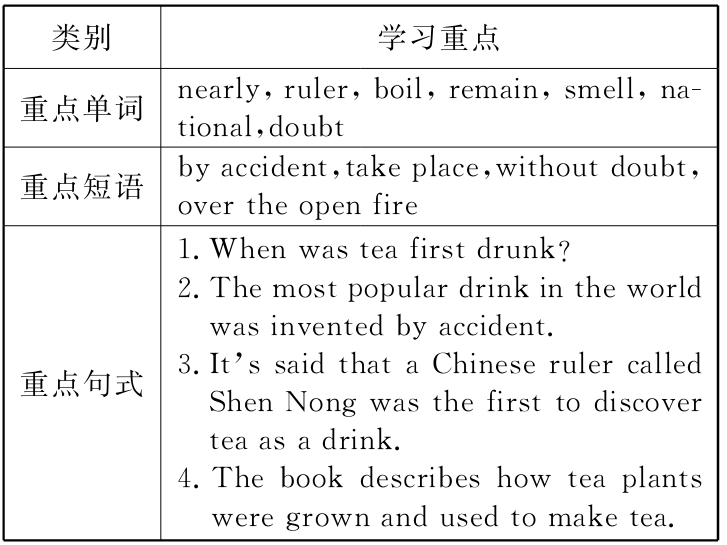
1.学生自学生词,并记住单词拼写和拼读。
2.预习课本,找出重点短语和句式。(见学案中预习检测的内容)
3.读记后完成预习检测作业。 课堂导学方案 Step1 复习
讨论:—When was …invented?
—It was … Step 2情景导入
T:Give three questions and lead in to new knowledge.
1. Do you drink tea every day?
2. Who invented tea in history?
3. Do people in other countries drink tea in their daily life?
环节说明:通过带着问题去学习短文,从而达到导入新课的目的,同时也可以使学生积极阅读短文,以了解更多的关于茶的知识。 Step 3完成教材3a~3c教学任务
1.要求学生快速默读短文,熟知大意,并完成课本3a的任务,然后邀请几位学生给出自己的答案,全班一起学习讨论。
2.先邀请几位学生阅读短文(可一人一段),教师要注意学生的语音,给予必要的朗读指导。然后播放录音,全班学生一起跟读。
3.读短文完成3b及3c的任务。
4.短文内容巩固练习。教师可给出一篇改写了的短文,将一些重点的表达方式空出,让学生在规定的时间内补全短文,然后找若干学生给出自己的答案。
Do you know the tea? Tea is the most popular drink in the world. But to our surprise, it was invented by accident. It wasn’t brought to the western world earlier. An ancient Chinese ruler Shen Nong discovered the tea when he was boiling drinking water in the open air. Some leaves from a tea plant fell into the water and remained there for some time. And it produced a nice smell. He tasted the brown water and it was delicious. And in this way, tea was invented.
环节说明:将听、说、读、写的任务结合起来,不仅锻炼了学生的语言综合运用能力,还巩固了学生对目标语言的学习、识记和运用。 Step 4小结训练
( )1. He is ______________ 50 years old.
near B. nearly C. nearby
( ) 2. The flowers produce a nice__________________.
taste B. sound C. smell
( ) 3. Some_____________from a tea plant fell ________ the water.
A. leaves, into B. leafs, into
C. leaves, off D. leafs, off
( ) 4. They all wished us _____________.
A. are remained B. to remain
C. remaining D.be remained
答案: 1.B 2.C 3.A 4.B Step 5 完成Grammar~4c教学任务
1.参考学案中“语法精讲精练”部分完成语法教学任务。
2.用4a~4c的练习来巩固语法知识。 Step 6问题探究
( )1. The food ________________ delicious. I needn’t taste it.
A. tastes B. smells
C. looks D. eats
( ) 2. I will stay in Wuhan for _________________ .
A. sometime B. sometimes
C. some time D. some times
答案: 1.B 2.C 教学反思
本课时主要回顾上节课重点句型:—When was…invented? —It was…。教师以提问的方式导入新课,让学生带着问题学习短文,增加了学习的目的性。同时,教师给出改写的短文,并要求学生补全空白,锻炼了学生的实际运用能力,巩固了所学知识,锻炼了学生的语言综合运用能力。
 川公网安备51152402000101号 )|网站地图


 发表于 2026-3-6 04:41:08